

Our visit to Dubai was full of surprises in that it wasn’t exactly what I had expected. Our favorite discovery was our tour that took us deep into the desert where we had the opportunity to ride a camel and enjoy dinner in a Bedouin camp under the stars.
Jay was hesitant. I don’t think he wanted to go. But in the end, he relented – albeit begrudgingly – and we stepped into our tour guide’s car at 3 p.m.
We picked up a young lady from Australia traveling alone and a Chinese couple with their son who was about eight years old. Our guide was from Pakistan. It was this international group who became our companions for the evening. It was an interesting mix of personalities sharing a unique experience; each interpreting it through the lens of his/her own culture.
The further we got out of the city, the more diverse the terrain became. It was dry and dotted with brush. The haze that had hovered over the city didn’t follow us into the desert. We were under a clear blue sky with the promise of a setting sun.
We drove by the building where “local” Muslims celebrate their marriages. We saw the houses “local” Muslims are gifted when they arrive home from their honeymoon. (I understood the “local” Muslims to be those who were born and grew up in Dubai.) The buildings were all white and looked to be made of concrete. The neighborhoods reminded me of our American housing tracks where everything looks the same.
As we passed a huge ranch where they shelter and train camels, our guide explained how important camels are to the Arabs. They are used for travel, food, and racing. It must have been time to exercise them as we saw tens upon tens of camels being ridden along the road. The camels are revered, he said and could cost up to $80,000 for a prize race camel.
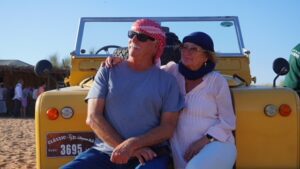
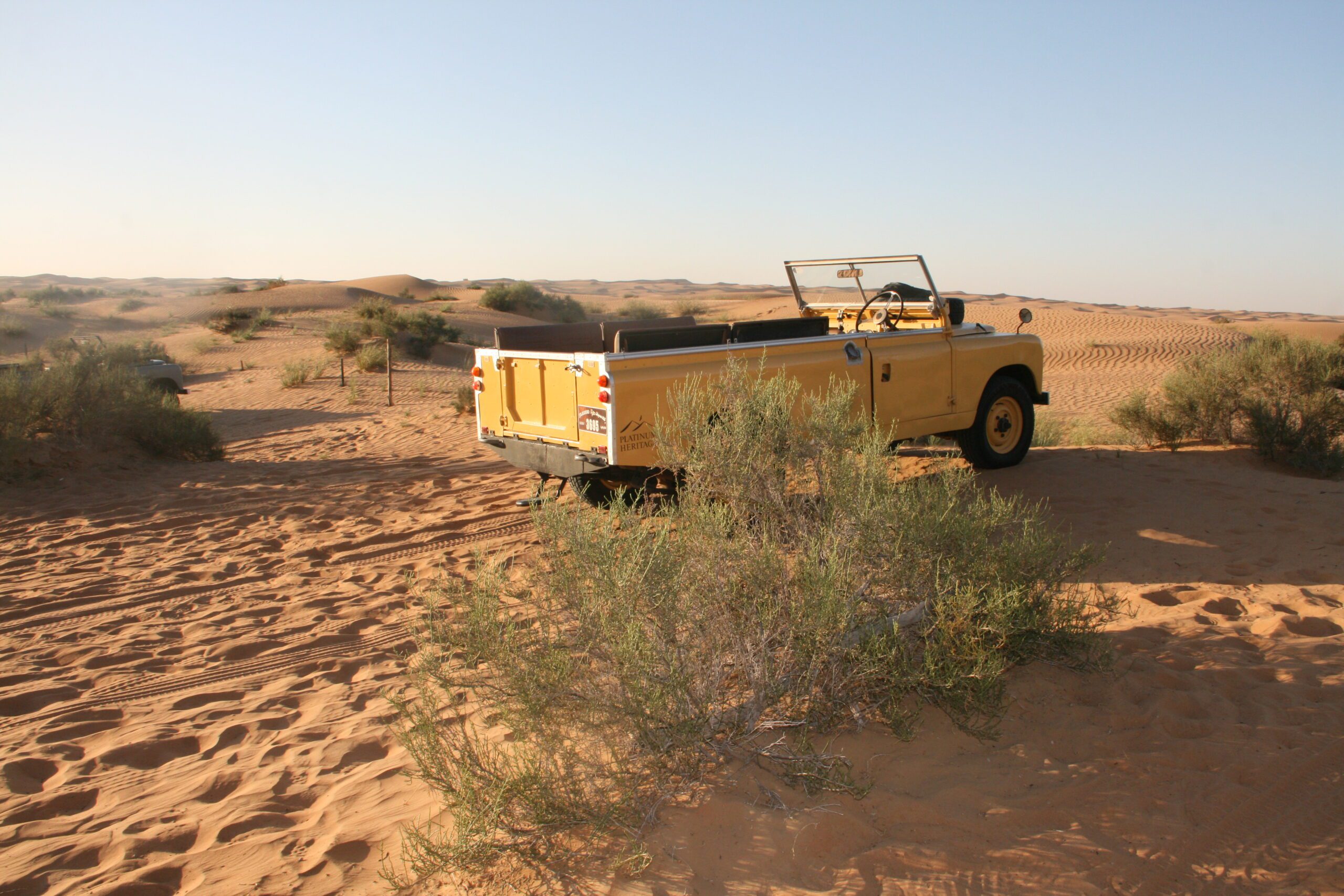
Our driver took us to a staging area where we were to pick up our desert vehicle, a 1960s-era Land Rover. Before leaving, our guides supplied us with a traditional men’s headdress, called a ghutrah – even for us women to wear. This led to a lot of self-conscious laughter as I felt it to be oh, so unflattering. I ultimately surrendered my ego and I admit, it was fun to get into the spirit of the adventure. Our group piled into the Land Rover and began our journey into the unknown.
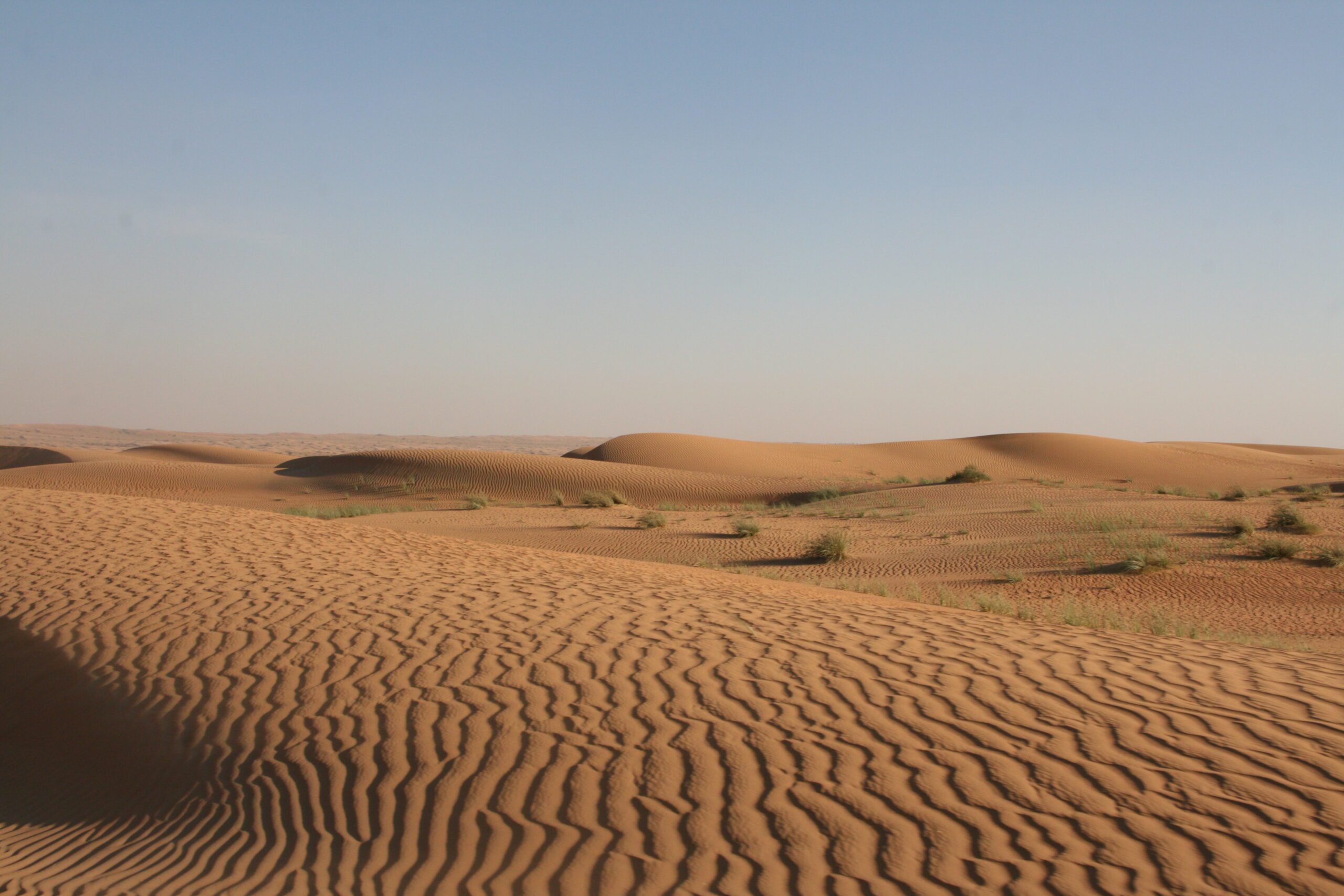
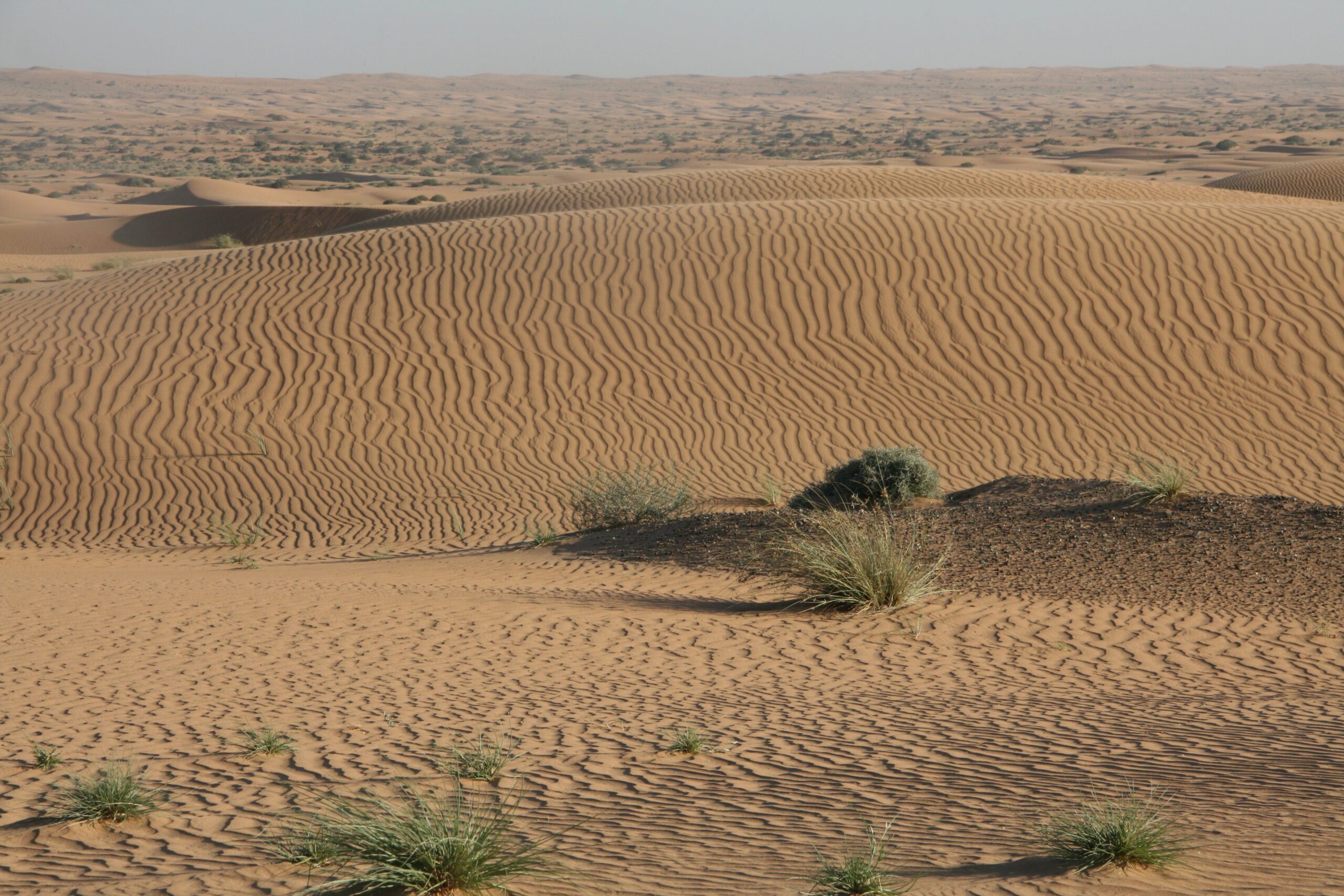
The desert that lay before us was unlike any other desert I have seen. Other than in movies. I’m very familiar with the Arizona desert. This was quite different. For miles and miles, golden dunes layered the horizon on either side of the road. The wind created dips and curves embedded in the sand that constantly shifted with the slightest breeze. It was hypnotic in its expanse. Every once in a while, we would see an oasis where green brush and a few trees dotted the landscape.
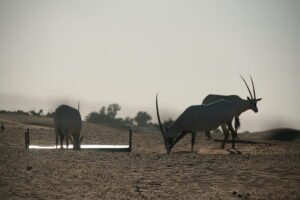
Our first stop was the Dubai Desert Conservation Reserve. Here we saw the national animal of Dubai, a desert antelope, the Arabian Oryx. They are quite odd-looking as they have long, skinny horns towering over their heads. Their horns are so long that they appear to be a burden to carry. They are used as defense weapons; lowering their heads to point their horns toward what they might deem to be a threat. And they have something unique in their brains that cools their blood, allowing them to live under such hot conditions. With the sun beginning to wane, we headed to the main event, our evening meal and celebration at a Bedouin Camp.
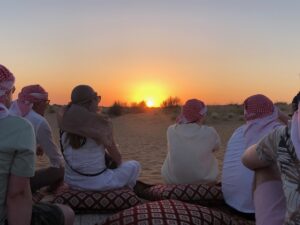
We arrived at the campsite to a warm welcome where they served us a glass of tea, then directed us to an outside area with pillows laid out in rows of ten. We were invited to sit down. The sun was low on the horizon and the air was cooling. Hushed voices carried over the desert. The first of our evening’s entertainment was about to begin. A man with his pet falcon walked over, cleared his throat, and asked for our attention. “Like our camels, falcons are revered here in the UAE…” he began. He proceeded to educate us about falcons and how they were once used by the Bedouins for hunting.
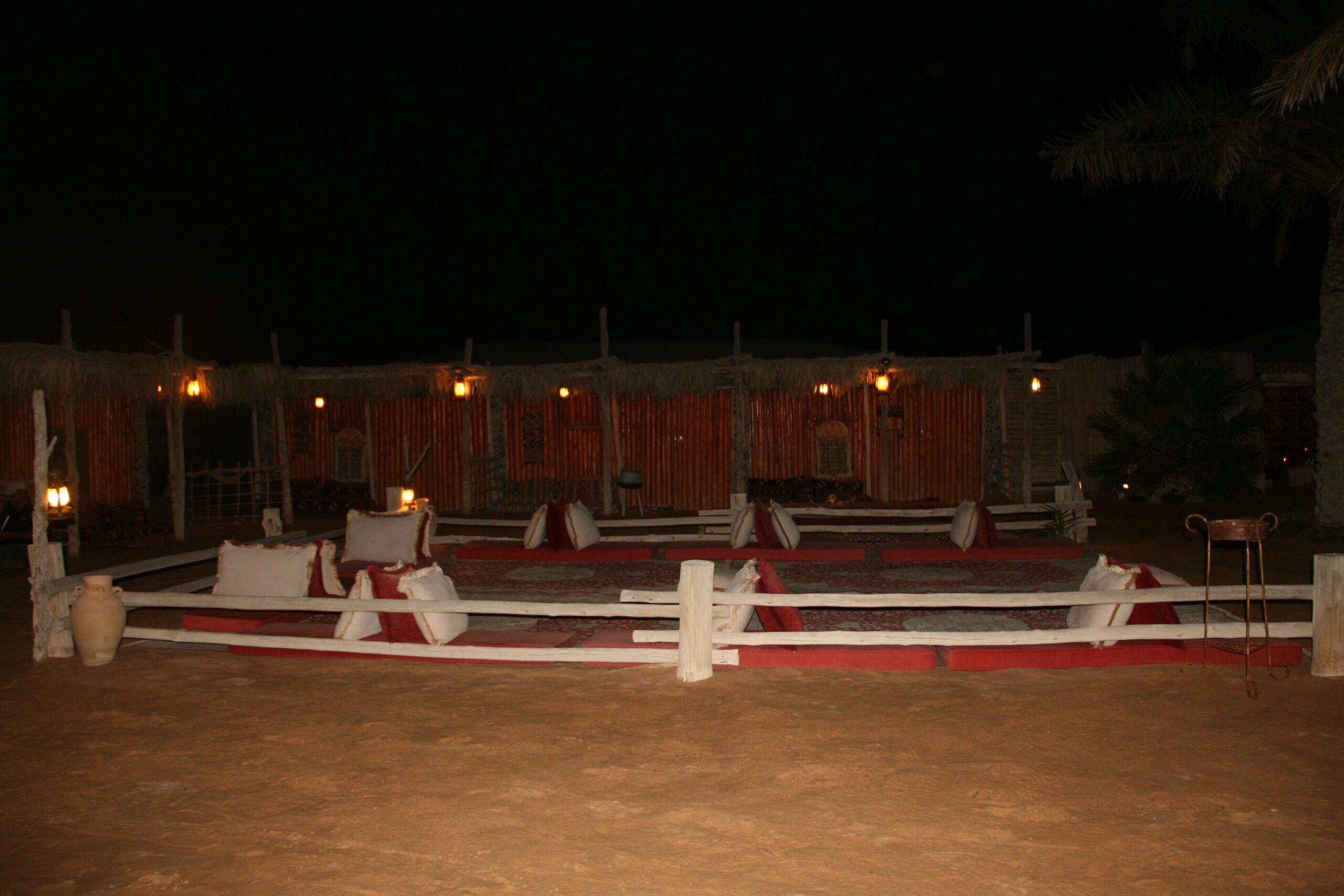
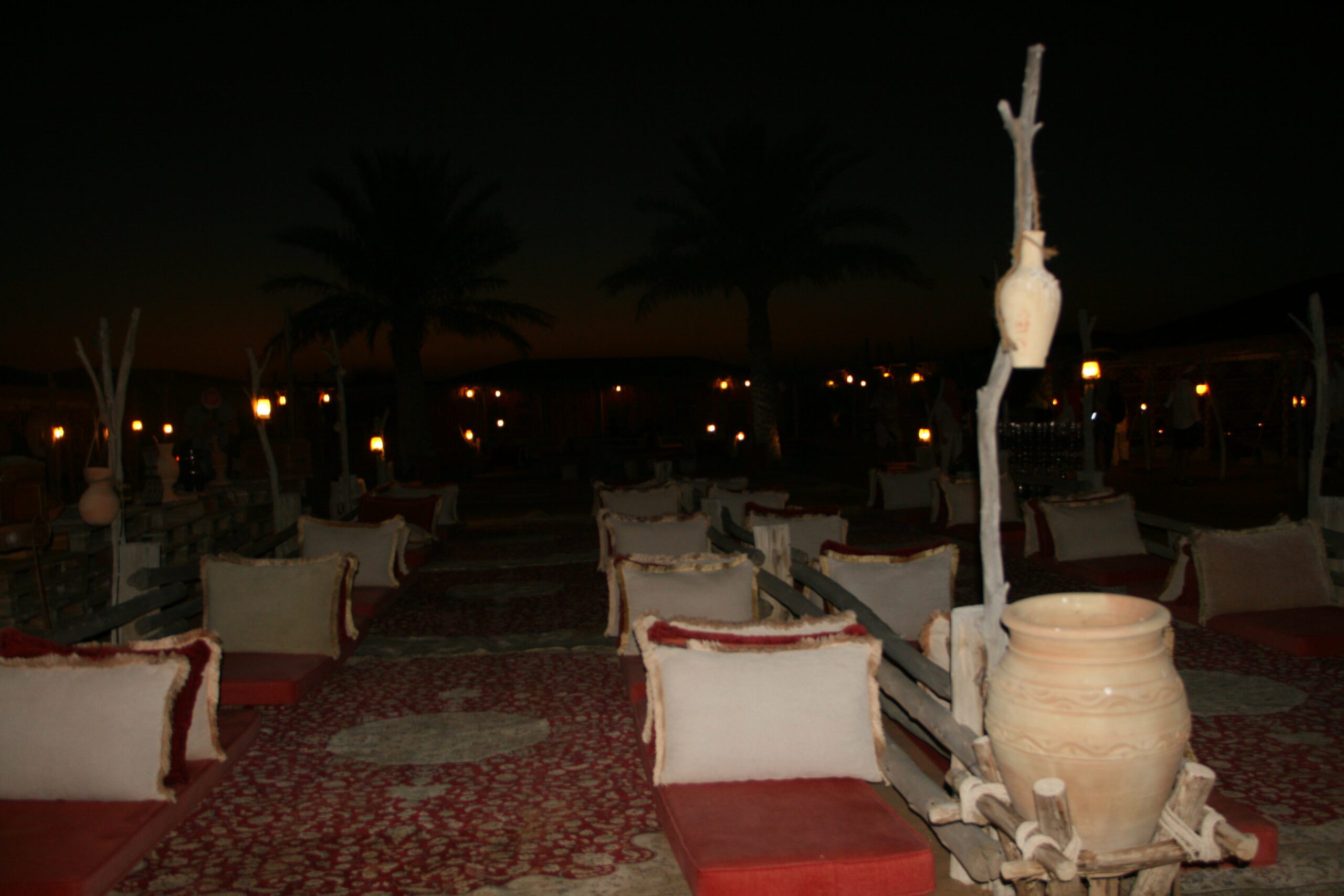
We wandered around the camp while the food was being prepared. Everything was set up for sitting low to the ground. The dirt floor was solid and covered with colorful Persian rugs. Plush pillows served as seats. Dining alcoves bordered the central gathering area with low tables also surrounded by pillows. Handmade pottery was placed strategically to spruce up the décor. We were shown a few sparsely furnished private rooms that were available for overnight visits. Oil lanterns were the only source of light and added a warm hue to the atmosphere.
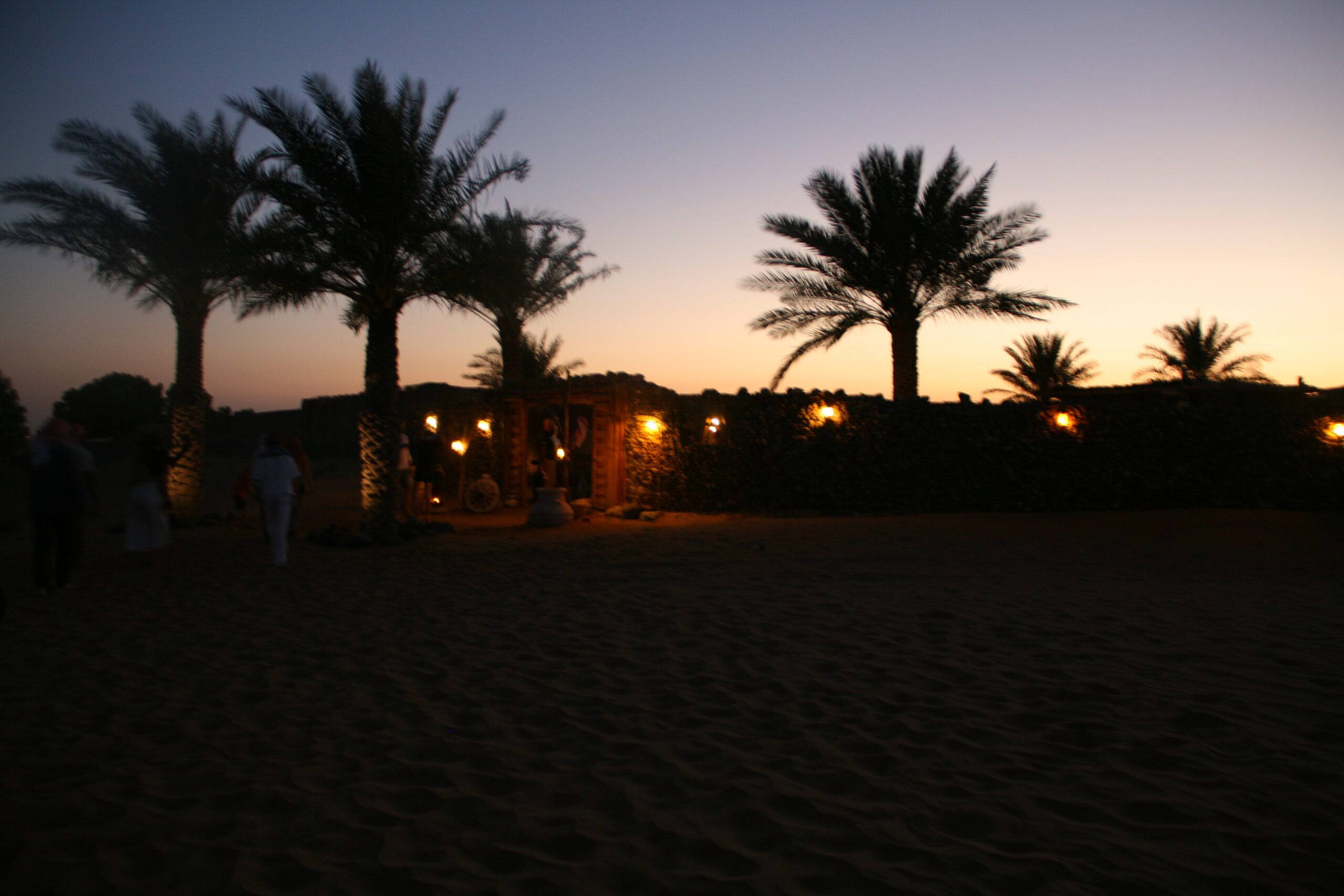
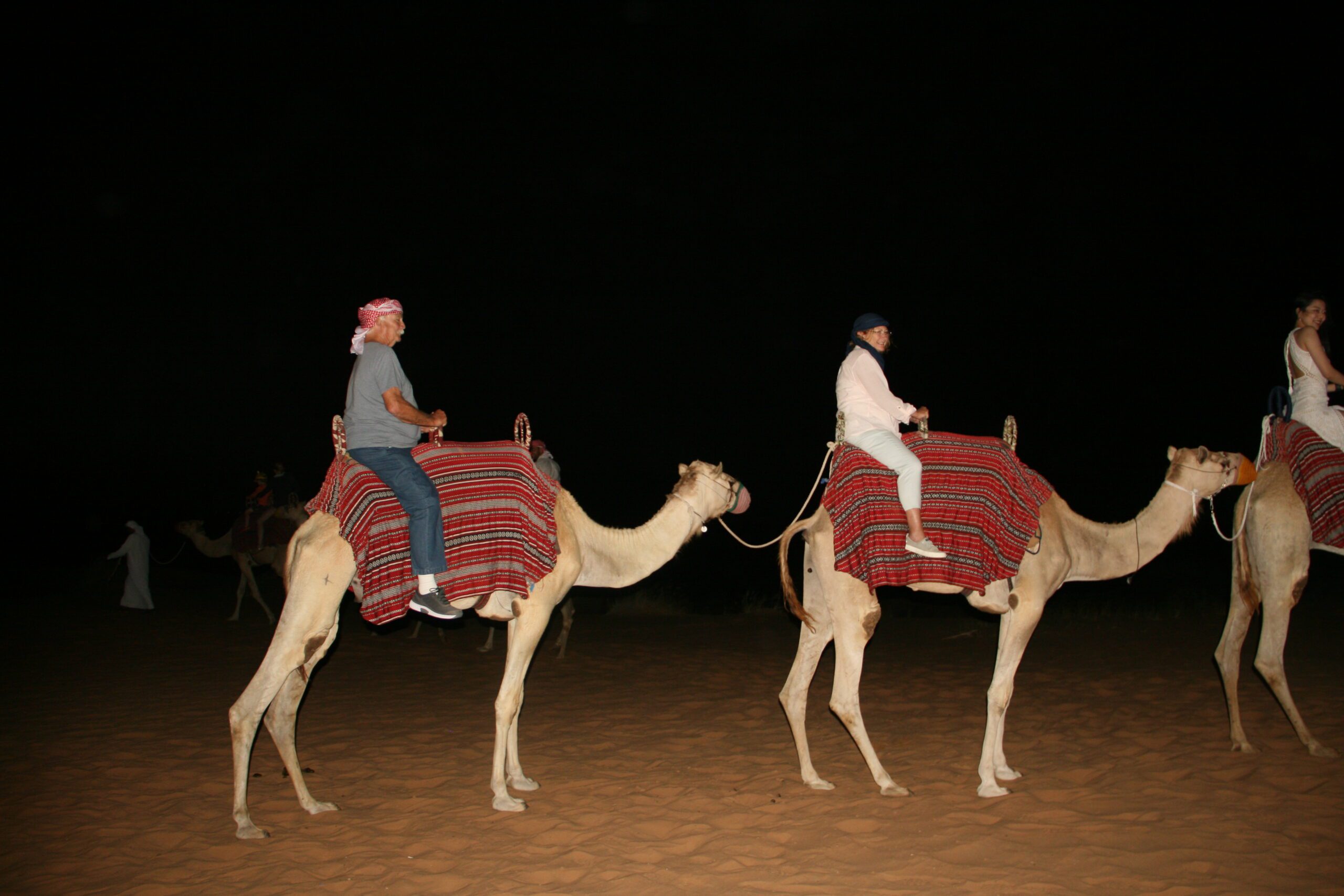
We watched as a man showed us how he made flatbread. A tattoo artist sat in the wings, drawing henna designs on women’s wrists. While that was interesting, I led Jay outside to the camels. I was all in for riding one. Jay not so much. He did join in on the fun. Although he probably wouldn’t have called it fun as his camel was a bit ornery. Vocal. Like he didn’t want to be carrying people on his back. Getting on and off a camel is a bit awkward too. It is a forward/backward motion that is jarring, and you feel as if you are going to fall off. It was a short ride and fortunately, neither one of us did fall off.
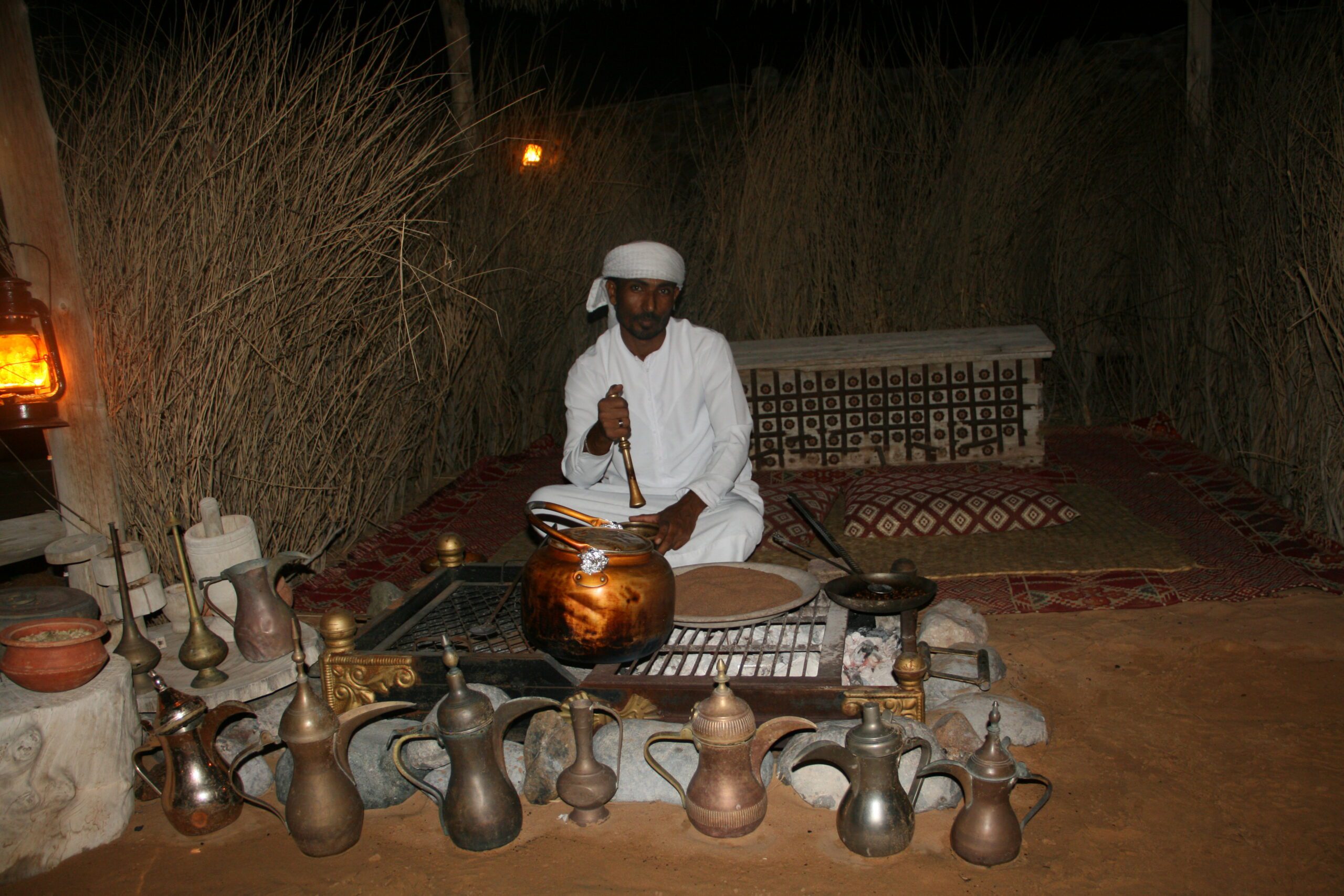
Later that evening we were treated to a traditional dinner. There was lots of lamb and some chicken all covered in their own unique sauce. Camel is a local favorite, and I took a bite. I didn’t care for it. I also tried camel milk. It was warm and salty. I didn’t care for that either. Vegetarian curry was offered for those who didn’t eat meat.
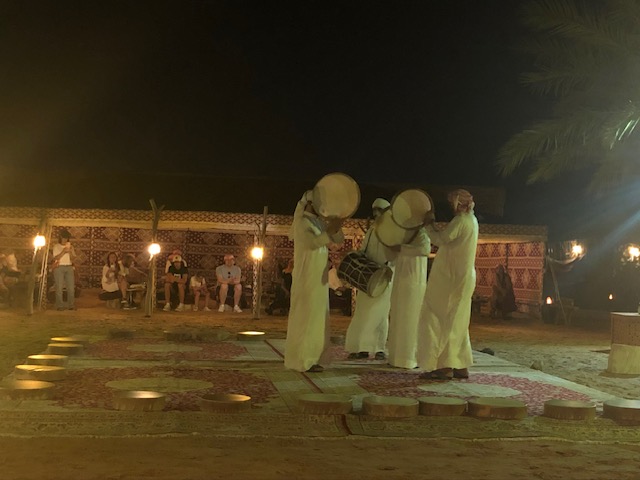
Each group sat together around a low table in one of the alcoves. It is here we got to share stories with our new friends from China, Australia, and Pakistan. Meanwhile, a few musicians came out to perform for us, singing and beating their drums.
After dinner and dessert, when our tummies were full to the brim, we were invited to move into the central area. If we chose to, we could partake in smoking a hookah filled with apple-flavored tobacco. Neither one of us smokes, but as the saying goes, “When in Rome…”
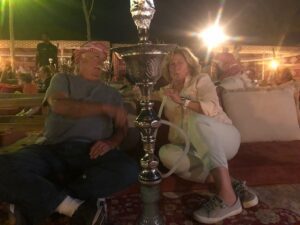
“The Bedouins were nomads and traveled through the desert at night due to the heat,” one of our guides said as the lanterns were turned off. All was dark but for the beautiful starlit sky above. Using a laser pointer, he explained the stellar formations and how his ancestors used the stars for navigation. It was magical and we could place ourselves in the cloaks of a nomad. The perfect closing for an incredible day.
It was just before dawn and still dark when I awoke to a loud, haunting sound echoing through the air outside. “Jay! Wake up!” I said, jumping out of bed. He sat up, “What is that?” He asked. I threw open the curtains and slid the glass door aside so I could step out on to the two-foot area they called a porch. We were on the eighth floor of the Sheraton Creek Hotel in Dubai. Our view was of the creek with the Burj Khalifa in the background as well as other famous buildings Dubai is known for. “I think it’s the call to prayer,” I said excitedly. I had heard it before in movies, but this was an entirely surreal experience. Everything was still but the echoing voices that carried over the city. This was our first morning in the United Arab Emirates.
I never wanted to go to the middle east. Certainly not Dubai. I had my preconceived – and ignorant, I might add – ideas about the city and its people. Materialistic was my first thought. With so much money and gold, I was sure the focus was all about wealth. Modern too. My preference is a city with buildings that hold a history of stories. Where, when you walk in, you can sense the shadows of its ancestors. And from everything that I heard about how women are expected to behave in the Middle East, there was no way I wanted to be subjected to that kind of treatment.
Boy was I wrong.
Well, not entirely. But it isn’t as simple as that, and I was about to get an education. Actually, both Jay and I learned so much from visiting Dubai. We learned about their architecture and their business practices. We learned about their culture and their religion. The people were welcoming and friendly. It was an eye-opening experience and with only two full days, we were able to explore downtown, old town and the desert. Our favorite experience was visiting a traditional Bedouin camp. But first I should explain why we were in Dubai at all.
We decided to take Emirates Airlines to Durban, South Africa and they stop in Dubai. It was a 12-hour flight from Boston to Dubai and another 8 hours to Durban. We thought we might as well stay in Dubai for a couple of nights and rest up for the next flight. Besides, we knew we would probably never go back to Dubai, so why not see it?

Dubai is not an old city; it was settled in 1833 with just 800 nomads. In 1971 it gained its independence from Britian and became one of provinces of the United Arab Emirates. Most of the city’s growth has happened in the last 25 years. And, I must say, the architecture is spectacular.
In fact, it would be a great place for someone who is studying architecture. Each building is completely original in its design. The city seems like it is competing with itself. Which building can be the tallest, the oddest shape, the most beautiful? There were too many to visit but we did manage to go up the Burj Khalifa, the tallest building in the world. Unfortunately, it was quite hazy that day but we could still see for miles and miles. The view was not unlike one when taking off in an airplane. The cars looked like toys.
Their mall is famous too. It goes on and on – and although we didn’t see all of it – we were told there is even a ski slope in it. And where our American malls are dying, Dubai’s mall was packed with consumers.
Our first tour began in old town. Our guide was Mohammad, a proud Muslim who was eager to share the history of his country and some knowledge about his religion.
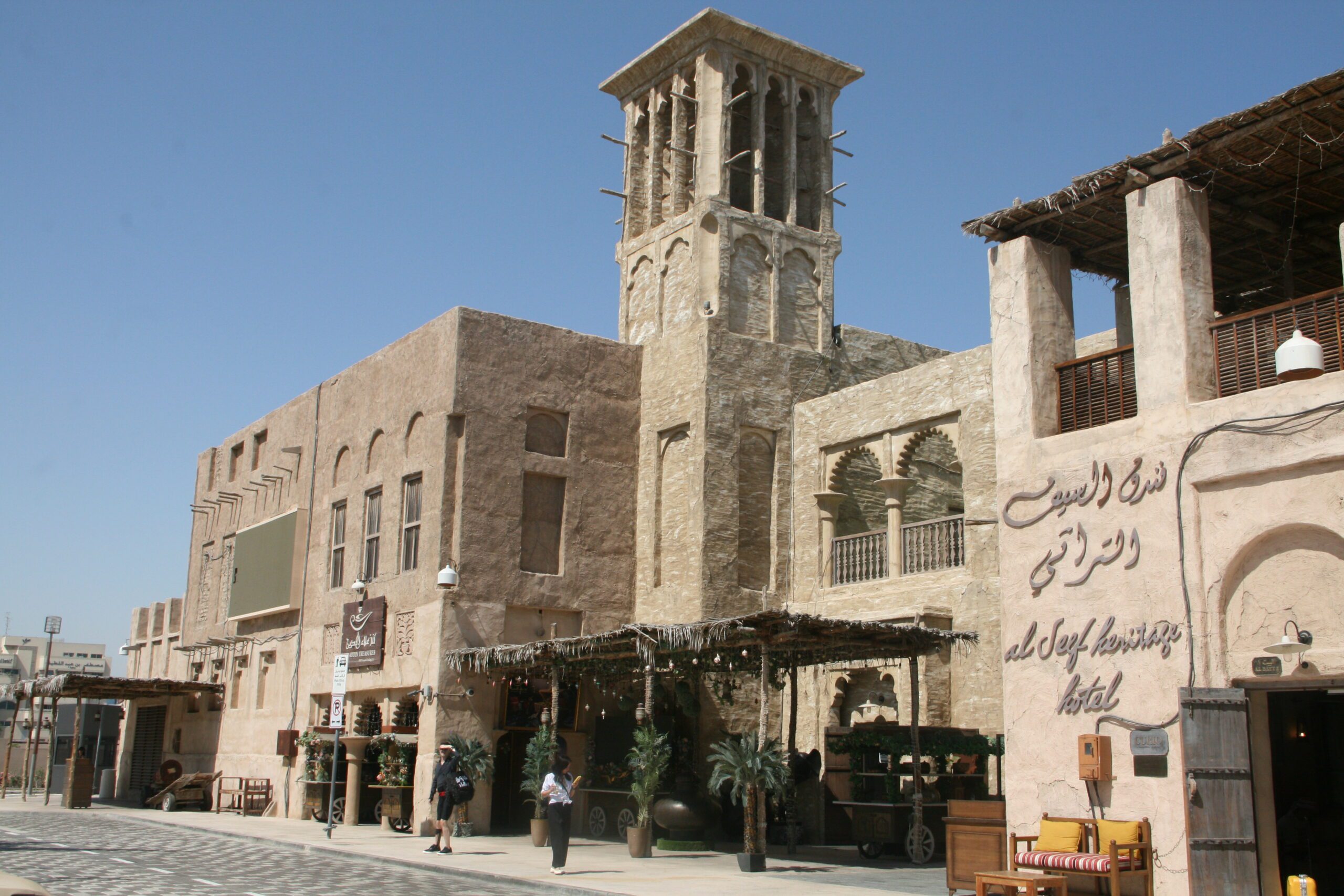
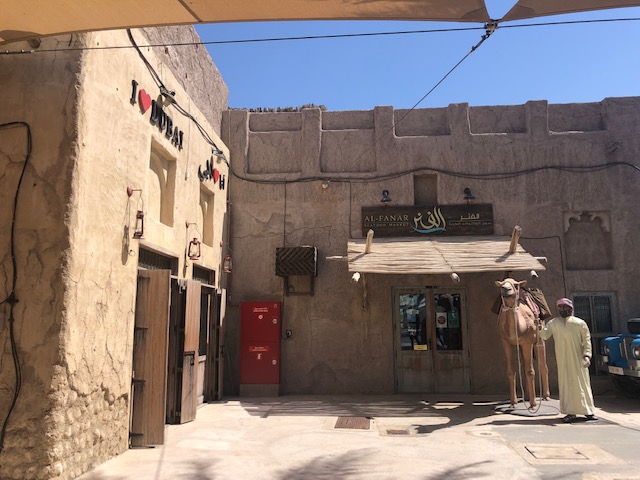
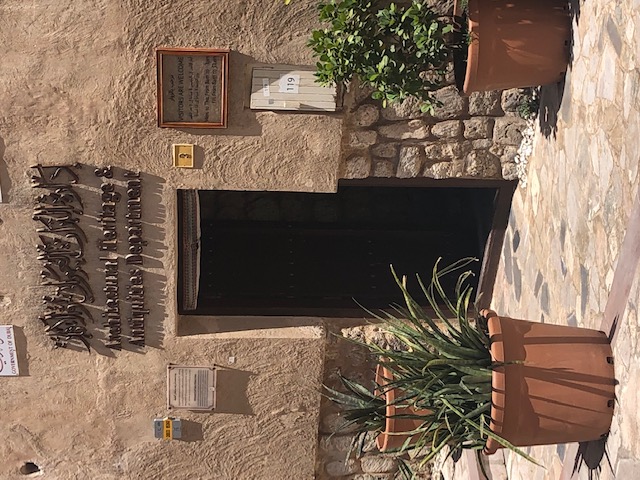
Dubai is an international city. It is clean and safe. There are no homeless people. If you can’t afford a home and your family can’t care for you, you must leave. Though we are told citizens are allowed to have pets (with permission), we did not see one dog or cat anywhere. The population consists of 80% ex-pats and 20% locals. It is business friendly as it is very easy to obtain a business license. There are no government taxes. We were told they get their revenue from the tourist industry. In fact, they rely on tourism for most of their income, not oil like we thought.
I was concerned about the dress code. Especially for women. As it turns out, the Muslims must adhere to their traditional dress but visitors do not. Women tourists are not asked to cover their hair and/or face. Men can wear shorts. We even saw some ladies wearing short shorts and halter tops. That was a surprise. Nevertheless, Jay and I chose to dress conservatively.
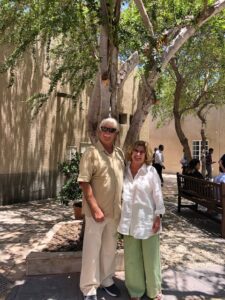
There are not just mosques in Dubai. There are churches, synagogues and temples. We were told there is a mutual respect for all religions. You just can’t preach in public.
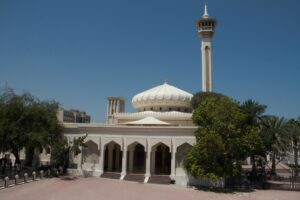
Muslims are called to prayer five times a day. Men and women pray in separate areas in the mosque. This is to keep them focused on prayer rather than be swayed by distraction.
The men can marry up to four wives. Each wife has their own house provided by their husband. The husband is responsible for the wife(s) and his money is “their” money. If the wife works, her money is her own. She does not have to share it with her husband. If a man divorces his wife, he is responsible for her financially and she still keeps her own money.
The “locals” are those who follow Islam and are born and raised in Dubai. They are entitled to a wedding that is paid for by the government. They are also given a paid honeymoon. And when they return from their honeymoon, they are given a house.
While sharing this information, Mohammad was always mindful to explain that this is their culture. He acknowledged it is different than many other religions and/or cultures. No judgement either way. It was his respect for our differences that made an impression. He was so thoughtful in how he shared his opinions, always sure to not offend anyone and at the same time, express his pride for his religion and country.
We moved on to a tour of a money bank filled with gold coins made throughout history.
When it got too hot, we stopped in an air-conditioned building and were served black coffee. Very good coffee – almost like Espresso. We were each given a small cup and then a gentleman came around and filled it halfway. By filling it only halfway, it is an unspoken invitation to stay and visit. If the host fills the cup entirely, it is a signal that it is time to leave after finishing their drink. This is their custom.
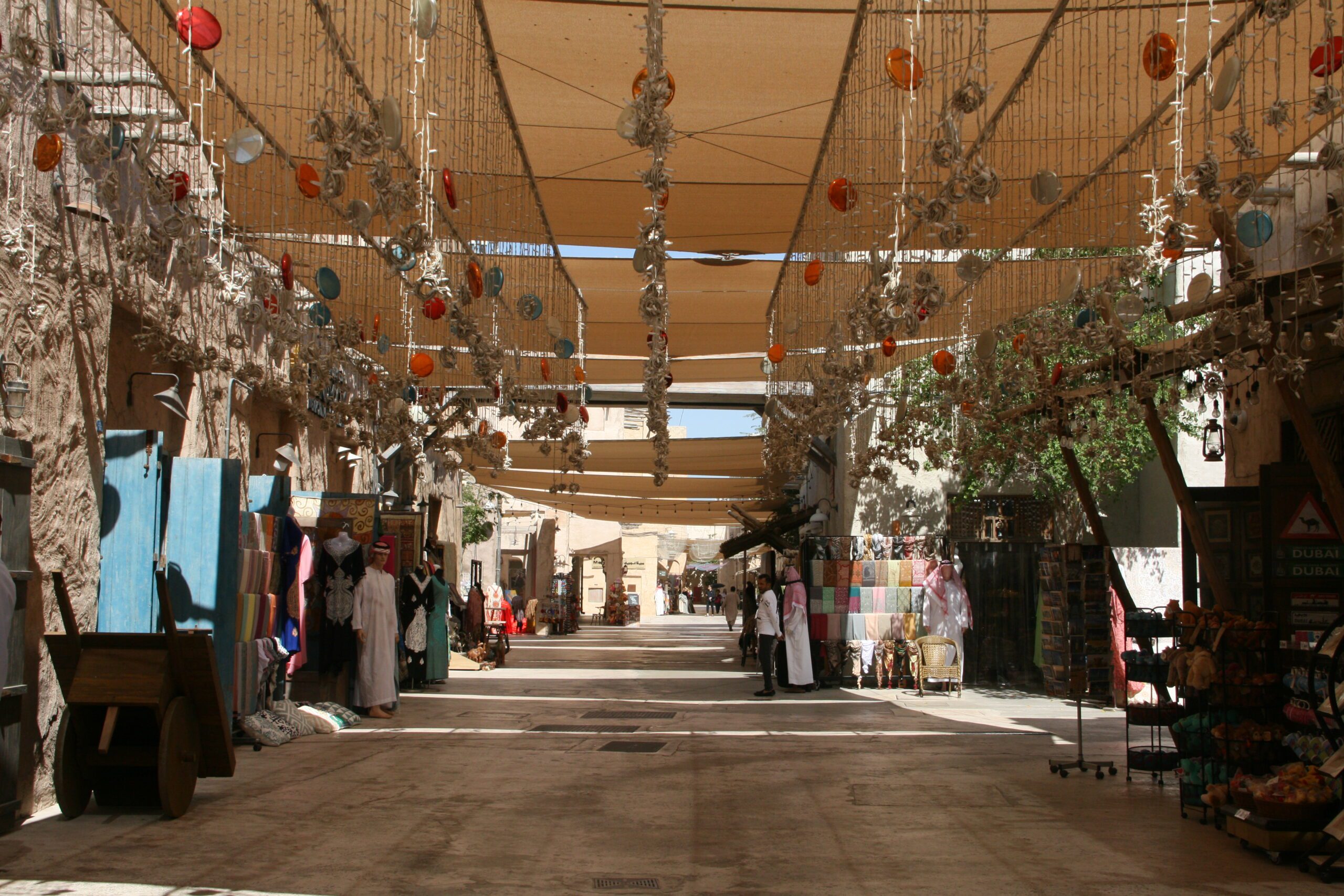
Mohammad took us to the first of the three souks that were on the tour. Souks are like American flea markets or the Mexican street markets where local vendors sell their goods. This was a general souk that sold a variety of items like cloth, artifacts, and trinkets. After a little shopping, we stopped to eat some local food and rest by the creek.
To reach the other souks, we took a Dhow across the creek. Dhows are a unique design that were originally sailboats and used for fishing and transporting goods. Some of the dhows along the Dubai Creek are still used for transporting goods but they no longer have sails. Nor do the ones that are used for shuttling passengers back and forth across the creek. They rely on engines now.
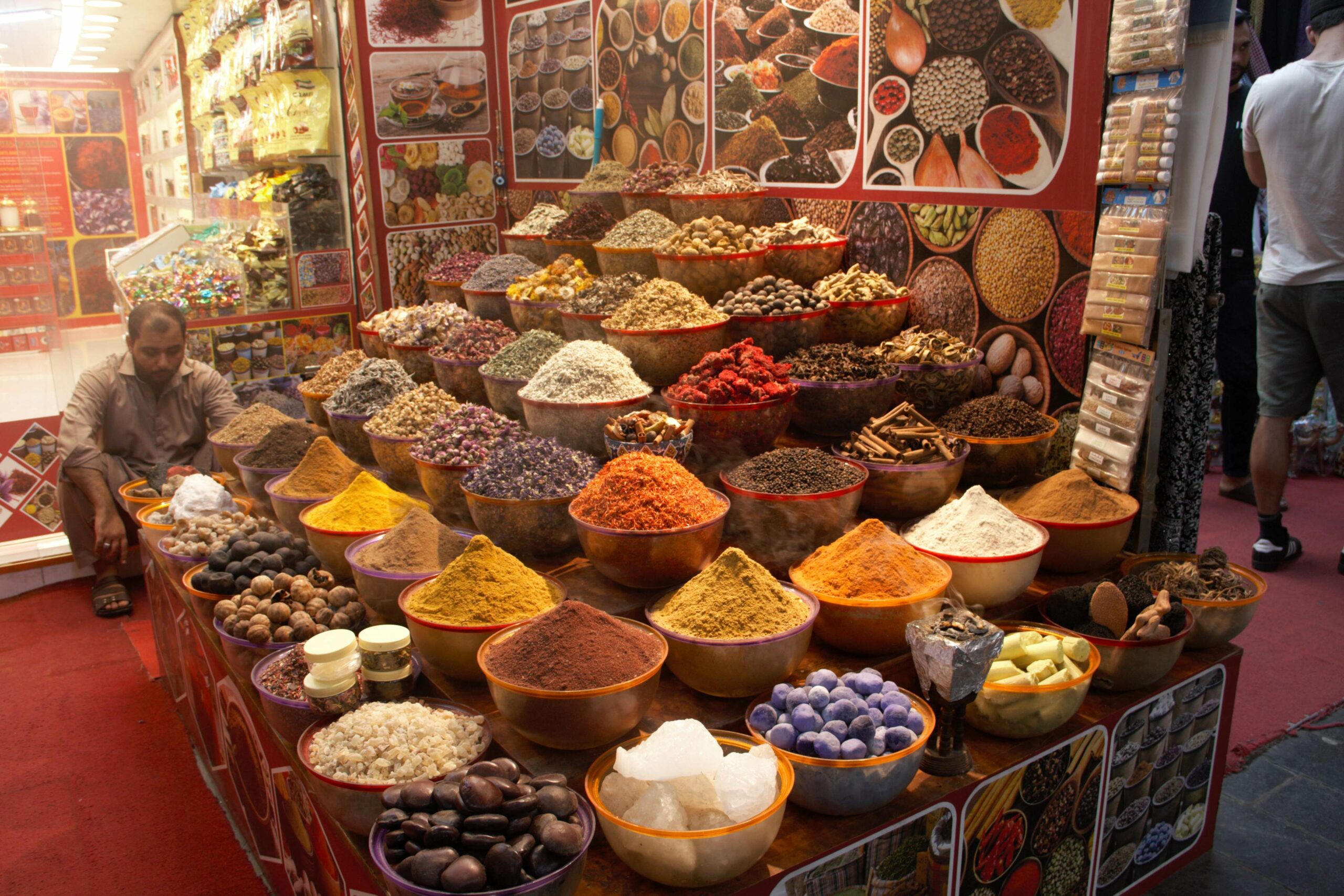
Next was the spice souk which carried a large quantity of fresh spices. Mohammad shared his knowledge on how to use some of the spices. Some were used for healing. Others for tea or seasoning. He told us a fact that we found particularly interesting; anything more than five grams of saffron could kill the person who ingests it.
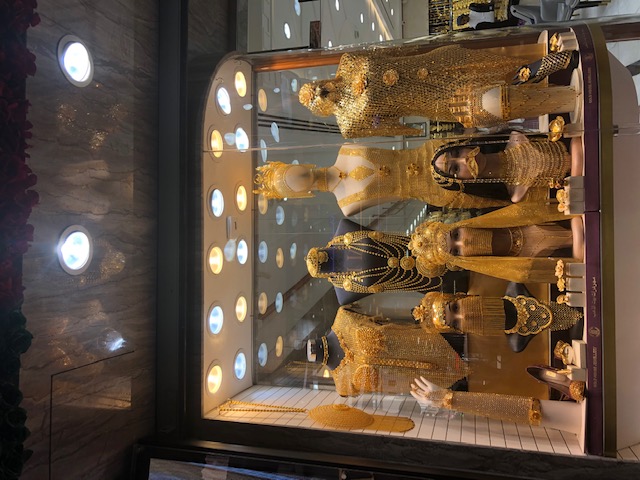
The last souk we visited specialized in gold. Gold seems to be everywhere. There was even a gold chandelier that was in the shape of tree in the Dubai Airport. It is deemed less expensive because tourists don’t have to pay taxes on it. The catch is you have to pay the tax up front and then redeem the receipt at the airport. I, of course, had to buy a pair of gold hoop earrings.
Our tour ended after the gold souk and back on the side of the creek where our hotel was. Jay and I originally thought we could walk back. Good thing we changed our minds and got an Uber. It was much further than we thought. It had been a long day, chocked full of information and lots of walking in the hot sun.
We ended our first full day in Dubai with a delicious lamb dinner at the hotel and retired to bed early. We wanted to rest up for the following day as we had scheduled a visit to a Bedouin Camp in the Arabian Desert. I was excited. Jay – not so much. He was skeptical about an 8-hour tour that took us into the unknown, eating foreign foods and riding a camel.
Keep an eye out for my next blog, Dubai, Part II – The Arabian Desert.



As we drove through the bush, I felt transported back in time. A time when humans were more connected with the natural world. With no outside artificial distractions, I began to tune in to my innate instincts, listening to the wind and watching the sky. Was it filled with clouds promising rain? Or was the sun showing off a silver blue sky? Maybe there were thin, wispy strands of clouds stretching far across the horizon, forecasting wind. Was that a zebra I saw, grazing amongst the trees? Were the elephants the ones breaking off branches, leaving a trail for us to follow? My nose twitched at the smell of dung as I heard a male nyala rutting off in the distance. A bird brushed my hair and landed on its perch. She sang a high-pitched song. Maybe there will be rain after all.
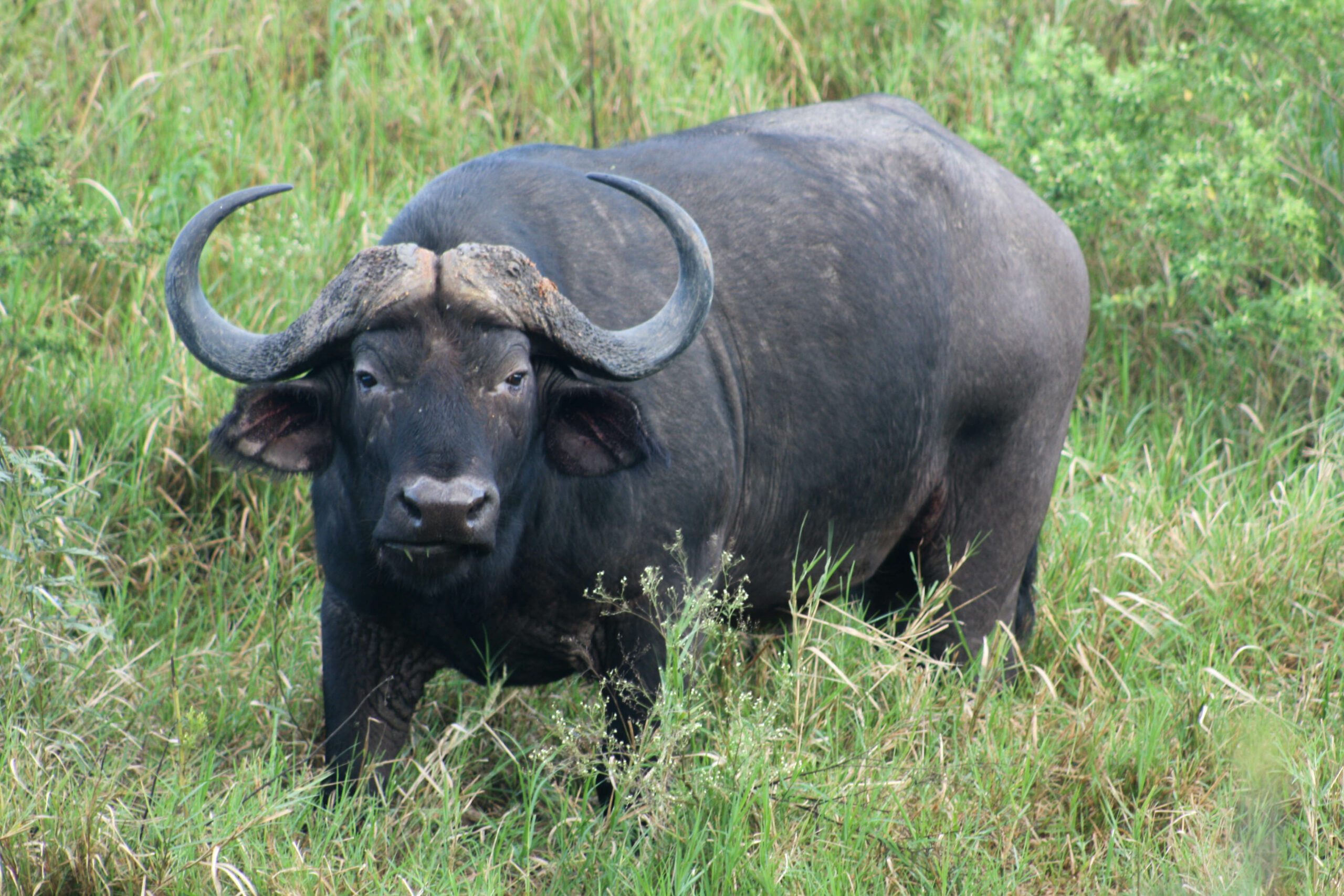
As Siya taught us the methods of tracking, I could envision myself living in the bush thousands of years ago. The illusion of a kinder, simpler time filled my thoughts. A time when the thunderous roar of our modern lives had yet to emerge in full force. But when we came across a water buffalo – and he stared us down – I knew my fantasies of the past were not realistic. I became acutely aware of how dangerous and challenging it was to live in that era. In fact, the same is true today; it is still a dangerous and challenging world.
Siya would often make a “joke” when passing a person on our bush drive, “And that is a Homosapien, the most dangerous animal,” he would say. We all would cringe, knowing he was speaking truth.
Many of us have heard about the endangered animals due to poaching. At Thula Thula, we heard horror stories that were personal to those rangers who care and protect them. Though elephants are certainly threatened, it was the rhinos that have been targeted at Thula Thula.
In 2017, two armed men broke into the Thula Thula Rhino Orphanage, taking the caretakers hostage and killing two rhino babies whose parents had been poached. It was a devasting and terrifying event which caused the government to shut down the orphanage.
In 2020, the reserve was again under siege by poachers only the sophisticated camera system and the quick action of the anti-poaching unit was able to stop them from hurting any of the animals.
Poaching is a consistent and never-ending problem. And difficult to combat.
Imagine if you were poor and were struggling to feed your family. Or you work at the reserve and are getting paid fairly but not the amount the poachers might offer for information. These are the kind of situations that tempt those in need. Poverty is not an excuse, but it might help one to understand what they were up against.
For the poachers, theirs is an even bigger payday. We were told that just one ounce of the rhino’s tusk can go for $4,000 or more in Asia. Why? The legend is that ground rhino horn is a powerful aphrodisiac. Others profess it to have healing powers. The truth? Their horn is made of keratin. The same thing our nails and hair are made of. There is nothing magical about it. Still, there is a big market for rhino tusk.
At Thula Thula, the anti-poaching unit works twenty-four hours a day. They patrol the fences on foot while carrying automatic weapons. They have air support, and they travel by vehicle. Every single person who works there is constantly aware of the on-going threat. While the rangers drive us by the border fences, they aren’t just tracking the animals, they are also looking for cuts or openings that could allow the poachers to enter the reserve. They limit their radio communication so as not to alert the poachers to where the animals are located. They do everything in their power to protect the animals.
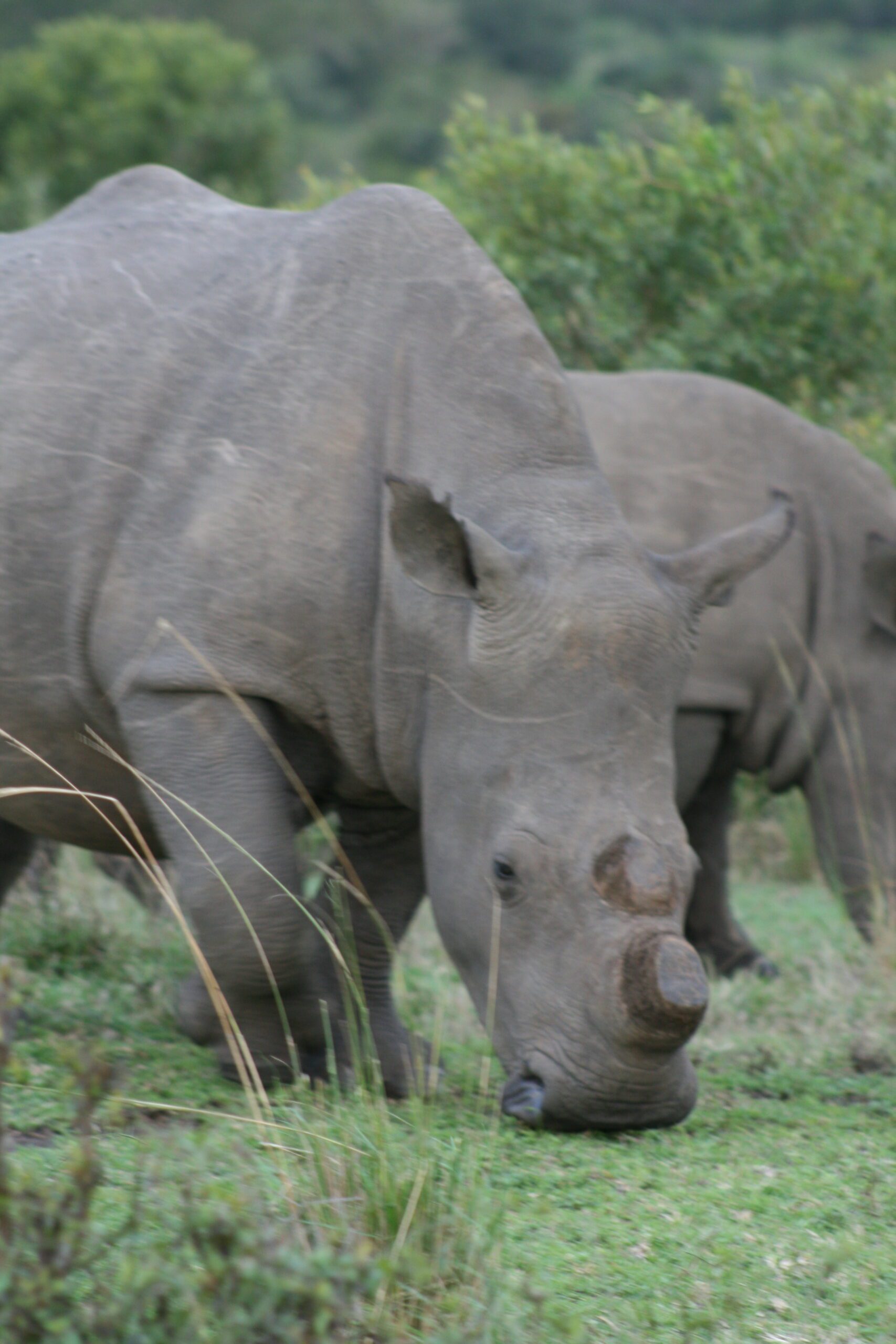
Another conservation practice that is being done at Thula Thula is the removal of the rhino tusks. You might have noticed in the photos of Thabo and Ntombi. They don’t look like other rhinos because their tusks have been cut off. It is not painful. They are made of keratin. Besides, they are darted and put to sleep prior to the procedure.
A helicopter pilot is hired to locate the rhinos. When found, the veterinarian shoots a sedative dart at the rhino from the helicopter. Once he falls, the veterinarian joins the ranger team on the ground and they work together to remove the tusk. Just like our nails, they do grow back so the surgery is repeated about every 18 months. Once they remove the tusks, we are told they poison them and put them into a safe.
At the tented camp area, there are several tusks scattered around. They were taken from deceased animals and are on display for the guests. Signs are posted saying they are poisoned to deter the poachers.
As long as there is a market for the tusks, the animals are not safe. It is a sad reality that could lead to the extinction of rhinos (as well as other species). They are many ways to help. A donation is one. (www.thulathula.com.) Or better yet, visit Thula Thula. You will fall in love with the animals as I did.
There are many reasons that draw people to the sport of boating. Some like the peacefulness of sailing across the water. Some like the thrilling sensation of the speedboat, bouncing over the waves with the wind ripping through their hair. Others like the adventure of cruising where you never know what you will find from day to day. It’s a complex mix of tastes and with it comes a complex group of people.
Some come just out for the day. Others spend weekends on their boat. And then there are those who chose to live aboard. The boating community is a microcosm of our larger land communities and in it, you will find all kinds of characters. The following is a fictional account of a real event that happened many years ago.
The Stranger at the End of the Dock
He seemed like a nice enough guy. Or, so they thought. But Jesse and Cate had no idea what trouble lie ahead. Well, Jesse suspected. Cate was clueless.
“Have you ever noticed Martin always carries a small black briefcase whenever he leaves the boat?” Jesse asked Cate. “He doesn’t leave without it.” Martin had his 90-foot motor-sailor – with no name – docked in the end slip next to theirs. “So?” Cate wasn’t sure what Jesse was getting at. “Hmm, I wonder what he’s carrying in that briefcase.”
Martin arrived in the harbor one cloudy afternoon while Jesse and Cate were shopping for varnish. They had run out of supplies while in the middle of refinishing their 44’Alden ketch, named Nice Ketch. (Jesse was a huge baseball fan.) When they returned, a beautiful, wooden boat, with no name, lie next to theirs.
A short and somewhat round man with a round face suddenly appeared on deck. His hair had streaks of gray. When he opened his mouth, he had a booming voice and wasn’t afraid to share his opinion. Martin introduced himself and said he had just sailed in all the way from Turkey. He loved entertaining and after a quick hello, invited Jesse and Cate over for his famous barbecue chicken. Jesse and Cate immediately warmed up to him and offered to bring the wine.
This became a weekly ritual. Every Friday night at 6pm Jesse and Cate, along with other guests from the dock, visited with Martin. They sunk into his soft cushions that lined the stern cockpit. In the center was a large mahogany table. He always had a vase bursting with the most beautiful spring bouquet, and always, always served the same chicken, marinated in soy, ginger and garlic. He loved to hold court, telling dramatic stories of his sailing adventures. He mentioned he had a wife that lived in Europe and two grown children stateside.
Everything seemed normal for a while, except for that black briefcase and that he had no visible means of financial support. Then one day, he untied the lines and left for Mexico. Eighteen months later he returned to share more tales of his adventures; of spending months in the tiny village of La Cruz and hanging out at the famous Philo’s Restaurant. Famous for good food and great music, Philo drew some of the best musicians from all over the world. Philo’s was something of a cult favorite for cruisers. Martin’s joyous storytelling was contagious and fueled Jesse and Cate’s dream of one day cruising to Mexico on Nice Ketch. They longed to see La Cruz and meet Philo for themselves.
Martin’s boat was a lot to handle on his own. While away in Mexico, he hired a young man named Kid. Maybe it was a nickname. He never said. Kid was tall and lanky. His thin, stringy, hair brushed his shoulders. His face was pot-marked and looked older than his age. And he was constantly moving.
One day, Jesse and Cate were sitting in their cockpit and Kid invited himself over. Martin was gone as he frequently was. “So where is Martin?” Cate asked Kid knowing she wouldn’t get a straight answer. Nobody ever seemed to know where Martin was or what he was working on. The answer was always the same. “He’s away on business,” Kid said. Whatever that meant.
Kid stepped into their cockpit and Cate offered him a beer to which accepted. He kept moving while sitting still. He rubbed his hands. He rubbed his face. He scratched his arms, his legs. His sentences didn’t always make sense. Jesse looked at Cate and could see she was uncomfortable. But Kid seemed lonely. Like a little boy whose mother abandoned him and his father frequently left him alone to hang out at the bar. They felt sorry for him and therefore sat quiet for the hour or two he visited.
About a week later, it was the middle of the night and Jesse and Cate were sleeping in the state room. Cate woke up and had to go the bathroom. They didn’t have the head plumbed so she had to go up to the bathrooms outside the locked gate of their dock. It was very dark but there were some lights highlighting the restrooms and the open field next to them.
Just as Cate reached the bathroom, she heard loud voices. She looked to her right and there was Kid sitting on the grass, yelling to someone she couldn’t see. If he wasn’t making sense before, he really wasn’t making sense then. He frightened her. He must be on some kind of drugs. She worried what he might do, should he see her. Cate turned and ran, as fast as she could, back to the boat.
Cate scrambled into bed and cuddled with Jesse trying to get Kid out of her mind. Minutes went by and she heard voices again. They were coming from Martin’s boat next door. Kid had brought another man and woman back. They stumbled up onto the boat and took residence in Martin’s cockpit. They were telling stories through garbled conversation that only they could understand. Laughter echoed through the darkness. It was eerie and it took Cate a long time before she fell back to sleep.
The next morning, around 7 am, Jesse and Cate were getting ready to close up the boat and go home. Cate grabbed her overnight bag and told Jesse she would meet him at the car. Fifteen minutes or so later, Jesse still hadn’t arrived. She returned to the boat to find Kid bruised and bleeding and frantically asking Jesse for help.
“You have to get these guys off my boat, man,” Kid was saying. “He’s crazy,” he continued.
(Two men and one woman on drugs is never a good mix.)
“If I call the harbor patrol or the police, Kid, they will most likely search the boat. They will confiscate the boat if you are holding anything,” Jesse warned. “Are you sure you want me to do that?” Kid insisted. “Just call them, man. Look what he did to me.”
Both harbor patrol and the police showed up within five minutes. They separated the three of them. Kid didn’t want to press charges against the guy who fought with him. Evidently, he was a friend. They let the friend go and he took off on his bicycle. The woman, however, was arrested after finding a stash of drugs in her car.
Jesse and Cate went back to their boat the following weekend. Kid was cleaning the “no-name” boat. Martin still hadn’t returned. Jesse and Cate were eating lunch in the cockpit when Kid’s phone rang. Cate noticed and couldn’t help but overhear his conversation. He was that close.
“No, Martin isn’t here,” he said, pacing. “I don’t know when he will be back.” Pause. “His voicemail is full.” Pause. “Okay, When I hear from him, I will tell him.” Kid hung up and went back to work.
Not five minutes later, three men arrived on the dock between Jesse and Martin’s boats. The dock was gated and locked, but somehow, they were able to get in. One wore a suit. The other two wore big overcoats and sunglasses. It wasn’t that cold. They stood on either side of the man in the suit watching their surroundings. They were all Mexican. “Where’s Martin?” the man in the suit asked, looking up at Kid who stood topsides with a mop in his hand. “I told you. I don’t know,” he answered nervously.
Jesse was in the middle of a sentence when Cate whispered, “Shush!” She nodded her head toward Kid and the three men standing beside the boat, clearly overdressed.
“When will he be back?” the man in the suit demanded. “I don’t know.” Kid said, his voice cracking. “You tell him, the man wants his money,” he threatened as he turned around to leave. The two men in overcoats followed him. Kid put down the mop and went below deck.
Jesse looked at Cate wide-eyed, “Shit,” Cate said. “That didn’t sound good.” Jesse agreed.
The following weekend, the story changed. “Martin had a heart attack,” Kid told Jesse and Cate when they returned to the boat. “Oh no! Where is he, Kid? Is he alright?” Cate wanted to know. “I’m not sure,” Kid was being vague again. “Somewhere in the valley, I think. But he’s not well enough to have visitors.”
Cate looked at Jesse as she put the groceries and her overnight bag on the boat. She climbed up the ladder, stepped onto the boat and turned around to face Kid, “Let us know when you hear something, please. We would like to send some flowers at the very least.”
“Will do,” Kid said, taking a phone call and moving inside for privacy.
“Hmmm…” was all Jesse said, looking skeptical while joining Cate on board.
It was Saturday evening and the sun was low in the sky. Jesse and Cate were back sitting in the cockpit, watching the boats come in after a day on the water. They also noticed a whole lot of people coming and going from the “no-name” boat. Martin’s girlfriend showed up. (He had since been divorced. Or, maybe he was never married. Who knows?) His adult children too. Several others joined Kid inside.
“It looks like they are having a party,” Jesse said. He could see them through the cabin window opening bottles of wine and chatting excitedly.
“I know. Why isn’t his girlfriend at the hospital?” Cate wondered. “And his kids.” Something’s weird about this.”
“Yup,” Jesse agreed.
The very next day, they watched as a parade of people started removing items from Martin’s boat. Out came the large television screen. They took bedding, pillows and anything they could find that wasn’t attached. Then, they started removing the electronics. They were stripping the boat. It didn’t look like Martin was coming back and they knew it.
“I don’t like this,” Cate said. “I’m scared. What if those men come back and all hell breaks loose? We could be caught in the crossfire.”
“I think the harbor master should get them out of here. They are putting us in danger,” Jesse said. “And I don’t think Martin had a heart attack. I think he’s hiding.”
Later that night, Cate had to go to the bathroom. It was 4 am. Walking up the dock, she noticed a trailer in the parking lot. That’s strange, she thought. Overnight parking isn’t allowed here. Just then, a car door slammed and two men got out and went inside the trailer. Two other men left. Cate went back and woke up Jesse and told him what she saw.
“I bet they are feds monitoring the boat. They were probably doing a shift change. Probably waiting for Martin to show up,” he said.
“This gets crazier by the minute. I just want them gone,” Cate worried.
The harbor master did finally tell Kid to move the boat from the private docks to the guest dock located on the other side of the harbor.
Cate and Jesse were relieved – but still curious. They drove over to the other side and found the trailer had moved too. “Still keeping an eye on them, I guess,” Jesse said. “I wonder if we will ever know what really happened.”
Six months later, Jesse got a text from a boat neighbor. Google Martin, it said. Martin had been arrested while driving through Texas. He was caught with several kilos of cocaine in his car and was now serving a five-year prison term.
“Wow! I guess that answers that question,” Cate said.
Monday, May 15, 2023
10:30 am – It poured again last night which made for very muddy roads. We didn’t see many animals on this morning’s drive. It is winter here and they were hiding in the bush to keep warm. The ride was bumpy with the truck slipping one way and then the other. Because of the conditions of the roads and where the elephants were headed, I’m afraid we won’t see our beloved elephants again.
It is our last full day here at Thula Thula. The weather is moody. Rain clouds hover above. From time to time, the sun fights its way through. But only for a moment. The wind comes in strong gusts bringing with it cold air. I am looking out from our tent over the bush where I can see the hills in the distance. So much wildlife wanders out there. We have seen nyalas, impalas, kudus, wildebeests, baboons, giraffes, zebras, rhinos, hippos, warthogs, buffalo, hyenas, and, of course, the elephants. We screamed and laughed at the monkeys. We even saw lions, though not at Thula Thula. And there was so much more. We were given lessons on the foliage and saw several dozen different species of birds and insects. The golden orb spider is one I will remember. He spins a web that looks like gold when the sun shines through it. So beautiful. Each bush drive was different, and the thrill was never knowing what we mind find around the corner.
8:00 pm – We are back in our tent for our last night. This evening drive we saw several animals we haven’t seen before: a chameleon, a bush baby, a jackal, and four waterbucks. Siya drove us down to the dam where we found the hippos close to where we stop. We had our sundowner cocktails while Siya mimicked hippo sounds. In return, they called back that laughing sound intermixed with some yawns. It was quite the show. At one point, we didn’t know which way to look. Hippos performing on our right and to our left, a new species for us, the waterbucks.
It was a beautiful sky with the sun setting over dark clouds and reflecting on the water. And it was so quiet. Peaceful. Breathtaking.
For eight wonderful days we immersed ourselves in the natural world. No news. No social media. We were truly living in the moment.
In the silence we heard the cheerful songs of birds, the powerful rutting of impalas, and the cries of hyenas. We heard the deafening sound of rain as we watched the storms come in. We awoke to footsteps on the roof of our tent.
We got to know our new Zulu friends and their culture. We shared stories with the other guests. And we ate way too much. I will miss Thula Thula and the people we met. But most of all, I will miss the elephants.
When I dreamt of Africa, I always envisioned a wide, endless landscape with animals roaming free. I had no real sense of what the areas surrounding the wildlife would look like. I hate to admit it, but my only frame of reference was the movie, Out of Africa, and that took place in Kenya in the early 1900s. Other than in cities, where do the people live? In what kind of homes? How do they survive, and do they hold on to their old customs or embrace a more modern way of life? We had so many questions. Fortunately, between our driver, Richard, and our ranger, Siya, we received many answers.
After four days at The Beverly Hills Hotel in uMhlanga (North Durban), Richard picked us up and took us on the two-and-a-half-hour drive to Thula Thula. It was pouring rain. So much so, sometimes we could barely see out the windows. When we did, we saw vibrant green rolling hills and pecan trees which led to miles and miles of sugar cane fields. Eventually, they gave way to flat land where tall trees that looked like stick figures lined the highway. We were told these are gum trees and are used for making paper. “Phew! What is that smell?” I asked Richard. “The paper mill,” he replied. “These trucks you see are carrying the logs to the port at Richard’s Bay. We also mine titanium, copper and zinc.”
The closest town to Thula Thula is Empangeni. As we drove through town, we were quite surprised to find out they had a KFC on practically every corner. “Everyone loves KFC here,” Richard told us. The town has a population of approximately 66,000. There were churches as many are Christian. There were mini malls and McDonalds and Burger Kings. There was even a Mercedes dealer! Outside the food market was a line of people. “Why are there so many people waiting in line? I asked. “They are waiting for their food cards. From the government.” (I was reminded of Cuba and the food coupons they get monthly, barely covering the family’s needs.) Some areas were neatly manicured and others held open-air markets on the sidewalks with crowds of people milling about and lots and lots of trash. I asked Richard about the trash problem but didn’t get a direct answer. “Maybe they don’t have enough cans or workers to pick it up,” he offered.
I should note, we were in KwaZulu-Natal, a province in South Africa that used to be called Zululand. Its inhabitants are predominately Zulu. These are the people to whom I am referring.
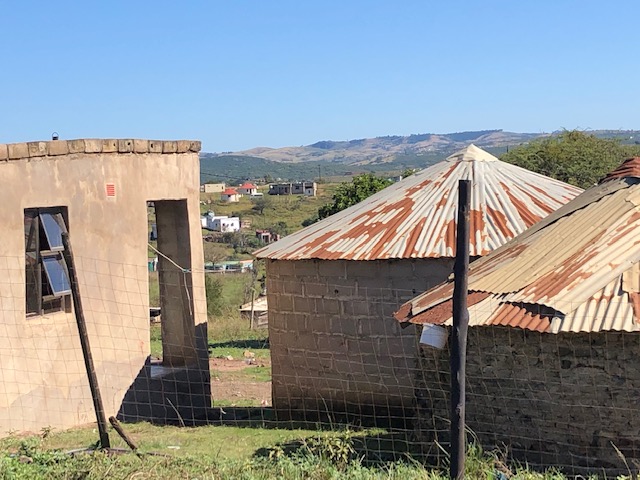
The roads turned to dirt as we left Empangeni. Surrounding Empangeni were several villages that lie across the hills. There was much more settlement than we expected. We noticed many of the structures were circular, one-room buildings. When we asked about this, we were told that each compound might have a small rectangular main house with the kitchen, living area and a couple of bedrooms. The round buildings were for grandparents, or maybe the eldest son. He would get his own one-room house built next to the gate so he could have his “friends” come by without disturbing the family. And there is always one building for their ancestors. They believe their ancestors stay with them beyond death. This is where they go to pray to them and to talk to them, looking for advice and gaining comfort.
Almost no one has a car. They walk everywhere while in the village and take the bus if they need to go to town or to work. Everyone owns cows and goats. Every morning they are let out of their compounds to roam and feed on the grass. Every evening the cows and goats find their way home. If they don’t, a neighbor will kindly return them to their owner. As we drove up and around the hills, we saw cows and goats grazing along the road, walking on the road and sleeping on the road. They looked to be healthy and well-cared for.
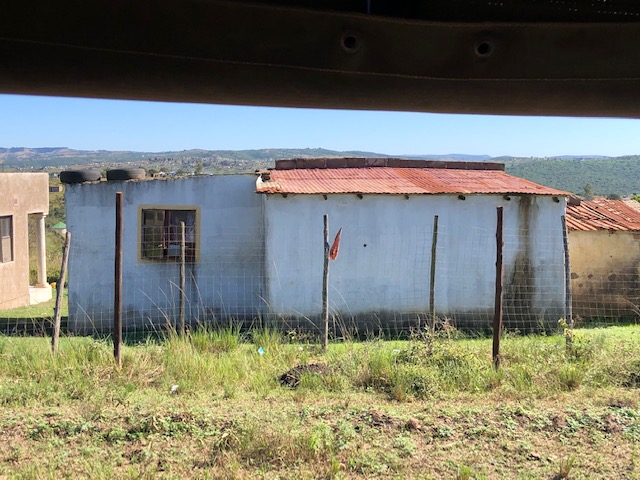
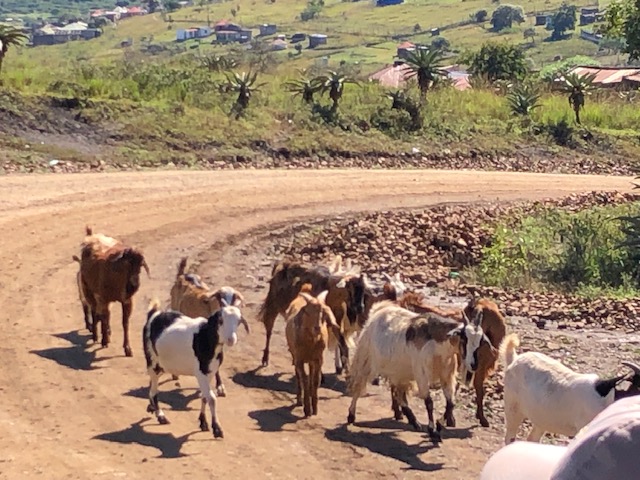
Just beyond the gates of Thula Thula is the road leading to nearby Buchanana Village. This is where we were invited to visit on day three of our tour. We were to meet a Sangoma. The Sangoma can be a man or a woman who through communication with his/her ancestors, is able to bring healing to the villagers. The one we were to meet was a woman.
Siya drove us into the compound. Three children were waiting for us. Curious to see us westerners, they peered out from behind bushes and then slowly showed their faces with big smiles across them. They giggled and said hello. Siya led us to one of the circular buildings. We took off our shoes as a matter of respect and entered the room where the Sangoma greets those who come for help. There she was. She wore a blouse with a leopard design and a long black skirt. Underneath her skirt she wore blue jeans. Perhaps the jeans were used to protect her legs from the contraptions she wore around her ankles. They were made from beer or soda can tops and were strung together to create a jingling sound when she moved or danced. She wore here hair in braids of beads and her feet were bare. Her eyes were focused downward. In the Zulu culture, it is impolite to look someone in the eyes.
The interior of the building was sparse. The floor was cement. The room wasn’t furnished. Her colorful sarongs hung against the wall. The Sangoma sat on a mat with her feet stretched out before her. We sat on rugs against the wall in a semi-circle on the floor. Next to her were a few candles and some ceremonial sticks. To the side of her sat two young ladies who we would learn were her daughters. Both were dressed more modernly than their mother. One was dressed in a short skirt and a tee-shirt. The other woman wore a tight-fitting long skirt and top. In front of her was a drum. Eight inquisitive Americans sat quietly as we waited for our lesson on the spiritual world of the Zulu people.
The Sangoma welcomed us with a dance while her youngest daughter beat the drum and we clapped. When she finished, we were encouraged to ask her questions. One person asked how she became a Sangoma. Siya began interpreting as she does not speak English.
“I started having dreams when I was twenty-three. Two men came to me who said they were my grandfathers and told me my gift was to be a Sangoma. I wanted nothing to do with it. The dreams continued but I kept denying them. One night my grandfathers asked me why I didn’t want to become a Sangoma. I didn’t want to wear the traditional clothing. I didn’t want to wear these things around my feet. I was afraid. Afraid the villagers would be frightened of me. I also was afraid I would fail. They told me they would guide me. But they also warned me that if I didn’t become a Sangoma, I would die. I agreed and went to train with other Sangomas.
“My first day, a man came to me who was very ill. I didn’t know what to do so I prayed. I heard my grandfathers tell me to give him a mixture of herbs and send him on his way. Several days he came back. He was well and very grateful. From then on, I knew I could rely on my ancestors to guide me.”
The Sangoma is well respected within the Zulu culture. And there isn’t necessarily one to a village. There can be several. We also learned that the Sangoma can heal spiritually, emotionally, and physically. “When the villagers come to me, they don’t tell me what is wrong. I tell them, she added. “If I cannot help them, I will send them to a modern doctor.”
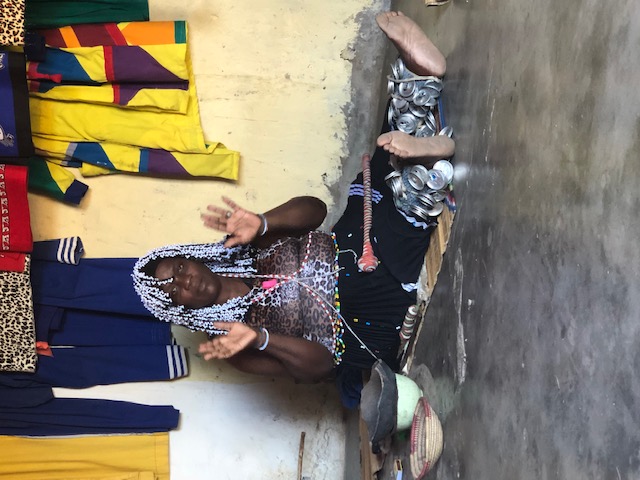
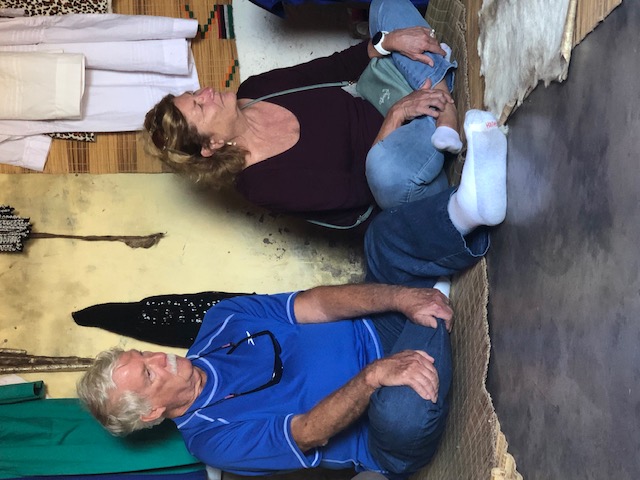
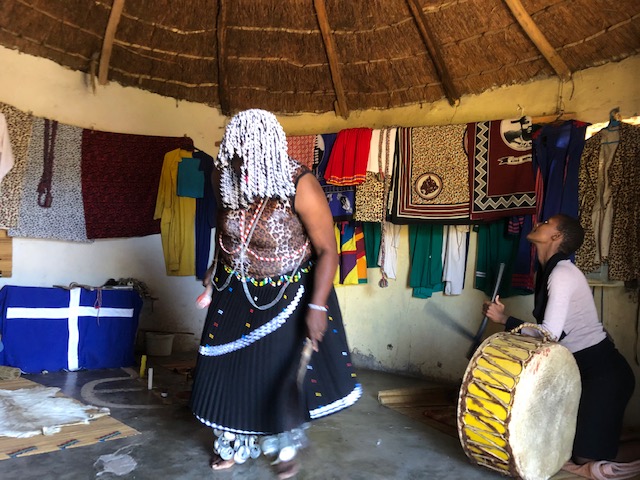
Frankly, Jay and I found the contrast between the old world and new world disconcerting. There was this woman dressed in her ceremonial garb with blue jeans peeking out from underneath. Next to her was her daughter, maybe twenty, wearing a modern and very slinky outfit. The Sangoma was a wife to a husband who had three other wives. She and the others live in an area where a dangerous wild animal could wander into their yard at any moment. We understand the villagers are poor, yet nearly every dwelling had a satellite dish. There is no indoor plumbing, and they have to collect their water from a communal area where it is delivered. They live with cows and goats as their main source of food and income and yet there were fast food chains in town. They don’t drive and yet a Mercedes dealer can be found in town too. I understand their desire for modernization, but my romantic (and somewhat small-minded) Out of Africa fantasy came crashing down fast.
NOTE: The Sangoma’s words are paraphrased from Siya’s interpretation. 
Visiting a private game reserve is a much more intimate experience than visiting a national park. First of all, it is much smaller making it easier for the rangers to track and find the animals. Second, those that have lived and worked at Thula Thula know their animals well, especially the elephants. And the elephants of Thula Thula are unique in that, although they are wild, they are still comfortable enough to be around humans.
Each of the twenty-eight elephants is named and each has their own distinct personality and quirks. I was especially pleased to find Nana to be alive and well as she was the very first matriarch of this herd. There she stood, not more than three feet away from me and staring at this newest tourist who had traveled such a long way to see her and her family.
When the original seven elephants arrived, it was Nana who became the new matriarch after witnessing the killing of two of her family members. And it was Nana who led the others to escape Thula Thula, not once but twice. The strength, power and intelligence of this magnificent species was able to knock down trees into the electric fence, allowing them to run free. Only the owner of Thula Thula, Lawrence Anthony, had other ideas.
Once the elephants were back and safely secured in the boma, Lawrence decided to set up camp just outside the fence. For three weeks, he walked and talked and sang to the elephants until one day, Nana stuck her trunk through the fence and touched Lawrence on the shoulder. It was then he knew it was time to let her and the other elephants discover their new home, the many hectares of Thula Thula. It was because of this one relationship between Lawrence and Nana that the others slowly learned to relax around humans.
So, it was with great reverence when I was introduced to this special elephant. Nana is easy to spot in a crowd. She came to Thula Thula with only one tusk on the right side of her face. She has since gone blind in one eye due to a cataract. Nana is smart and sensitive to the emotions of her herd. She is no longer the matriarch as she handed that off to Frankie when she lost her eyesight. Unfortunately, Frankie has since passed. It is now Frankie’s second daughter, Marula who is the current matriarch. But Nana still guides the herd with the wisdom of a grandmother and she is respected by the others as such. Often she will stop and take a nap just like our elderly. But don’t let her fool you, she still is a clever soul and can be quite mischievous at times.
“Nana took our bush coffee!” one of the guests said when she came back from their morning game drive. “She came right up to the back of the truck, used her trunk and knocked over the box, spilling out the contents all over the road. All the elephants came over and all of a sudden there were a dozen trunks checking it out,” another guest added. “Then Andrew climbed up on the roof and hung over the back of the truck trying to get the stuff back. It was so funny,” the first woman continued, laughing. “Here look!” And there it was, all documented on their cell phones.
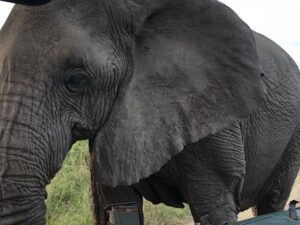
Nana
We had our own run-in with a misbehaving elephant. It was the day after a helicopter was on the premises to dart the buffalo and test for hoof and mouth disease. The elephants don’t like the helicopter noise (as they, too, are darted from time to time) and were agitated.
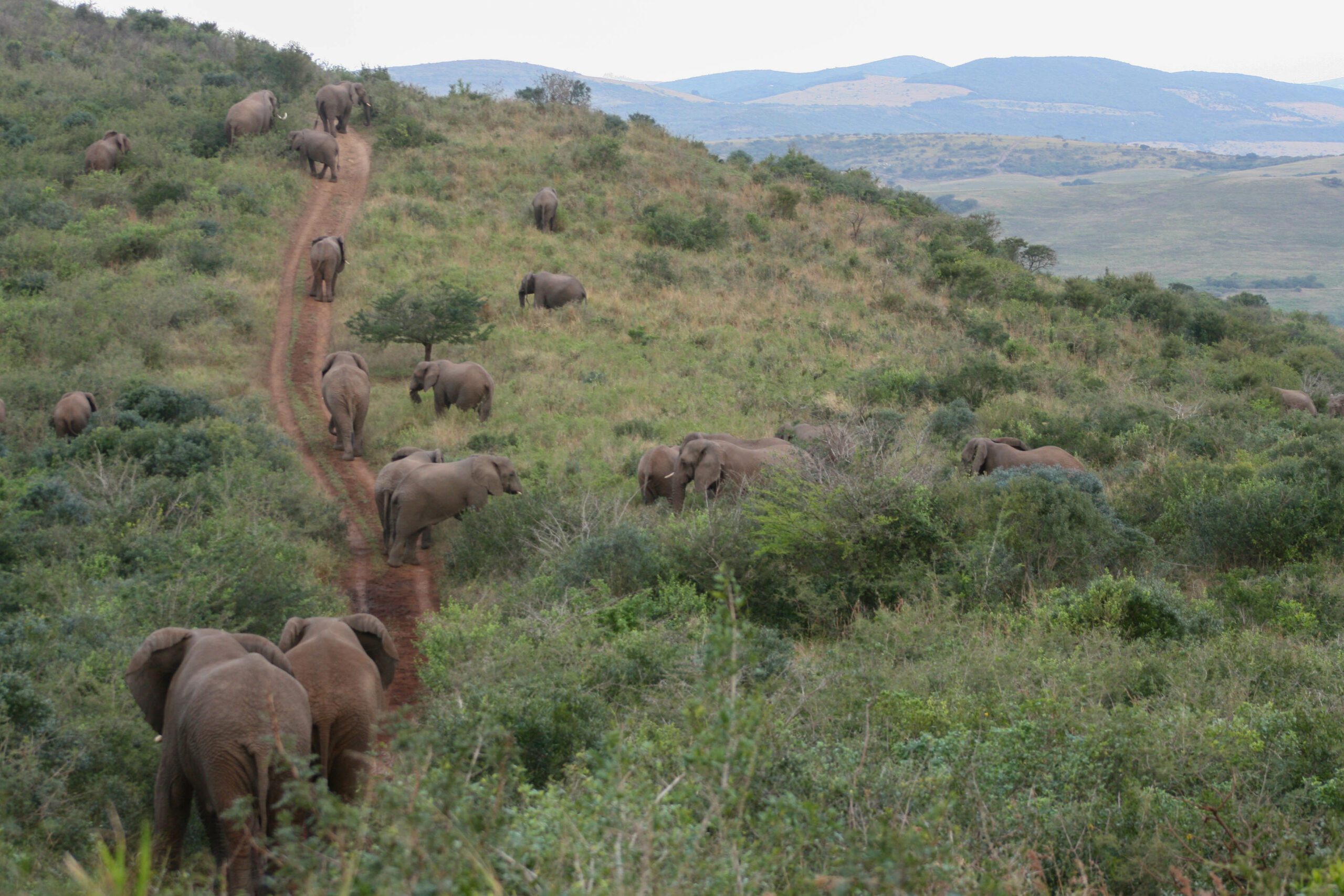
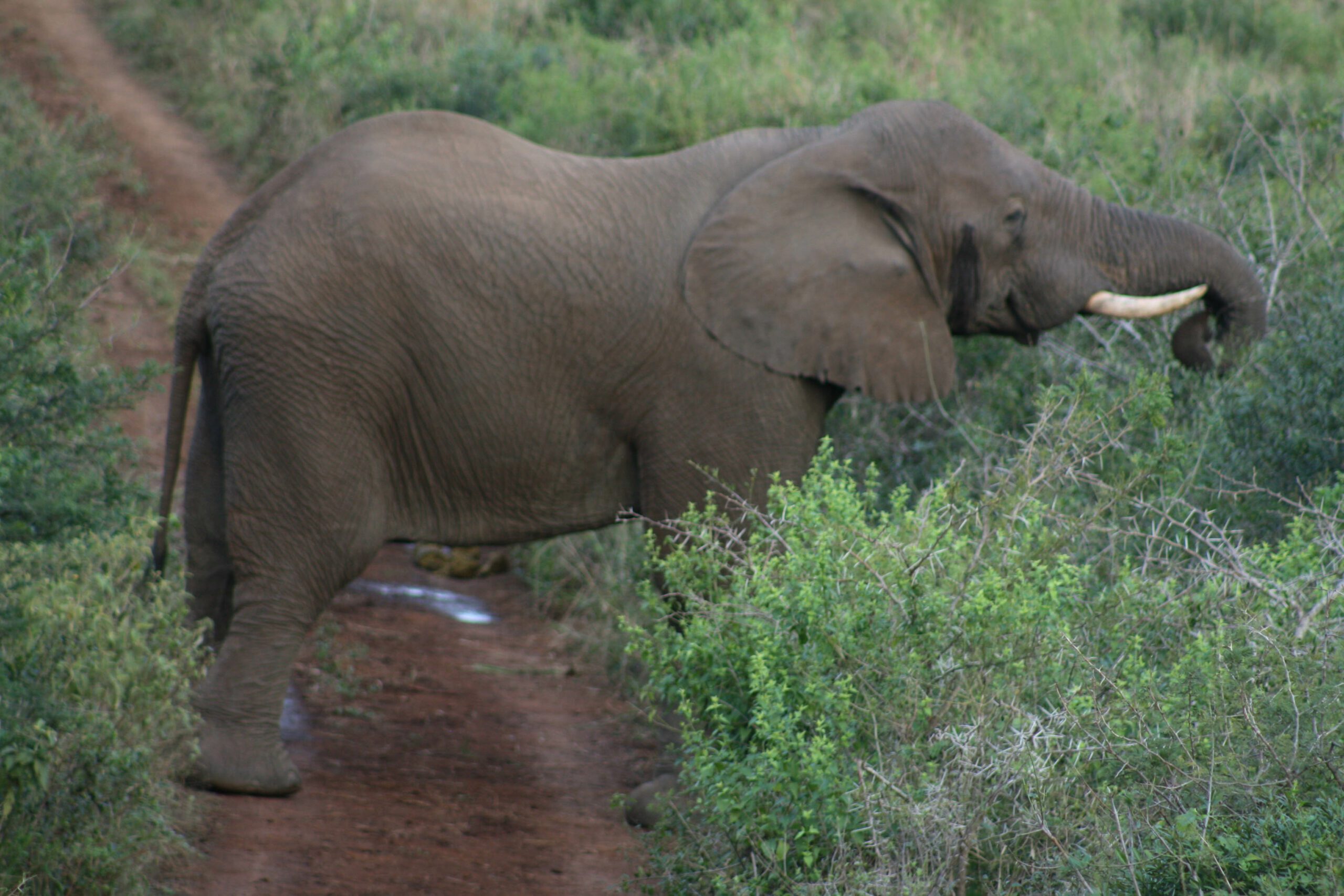
When we found the elephants that afternoon, they were heading up a long, narrow road with thick bush on either side. Siya stopped the car about forty yards behind them. While we were watching them, we heard elephants trumpeting as they were coming up the hill behind us. It was two very large males, Shaka and Bafana. Siya said they had probably been fighting as Shaka was feisty. He was trumpeting and dancing around, shaking his trunk. Suddenly, he came barreling down the road straight for us. Jay and I were in the back of the land cruiser. “I think it is time to move,” Jay said quietly. Our ranger, Siya, tried to start the car but because it is diesel and needs to warm up, we weren’t going anywhere and Shaka was coming fast. I turned around to face the front and got as small as possible bracing myself. Both Jay and one of the other passengers reported that one of Shaka’s tusks came in between Jay and me. With his big body having all that momentum coming down the hill, he kept moving alongside the vehicle. About ten feet in front of us, he turned around and after a minute or two of dancing around came back at us.
Siya was still trying to start the car. Even if he got it started, there really wasn’t anywhere to go because of the thick bush beside us and elephants in front and behind us. Before we knew it, Shaka was pushing the vehicle and then kicked it. His brute strength pushed the land cruiser up on its side and onto two wheels. Then it dropped just as quickly on all four wheels. The motor started and Siya moved us out of the way.
We all stared at one another as if to say, “Did that really happen?” followed by a bunch of nervous laughter. Even Siya seemed shaken by Shaka’s actions. “He was just riled up and wanted us out of the way. He was playing. He didn’t want to hurt us,” he said. And Shaka was fine after that. He casually walked to meet his family as if nothing had happened.
To us, it was a moment to remember.
-
- Shaka & Bafana behind us
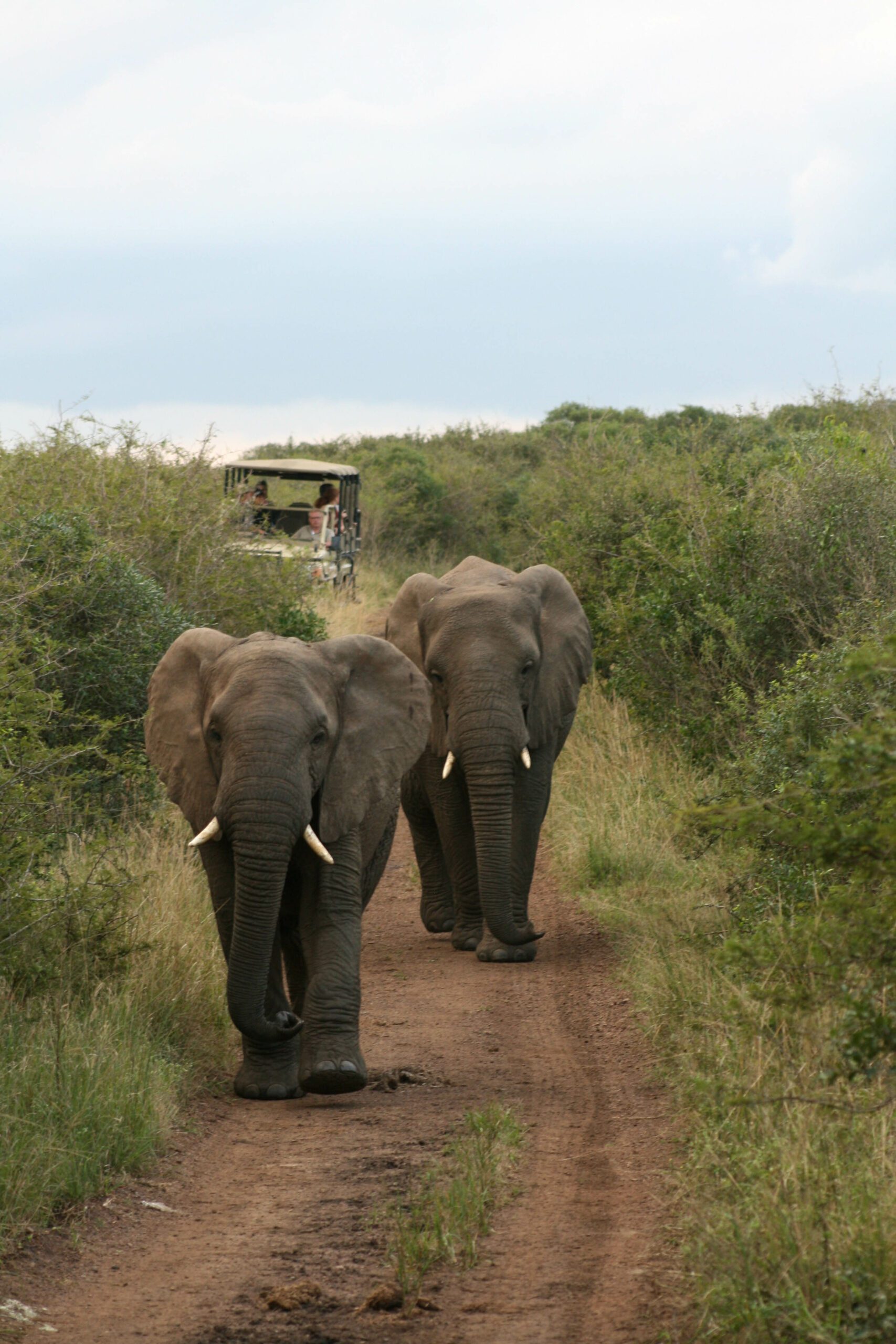
-
- Elephants in front of us
-
- Shaka Prancing
Then there is Thabo. The rhino with an attitude. Thabo came to Thula Thula when he was only two months old as a rescue from a rehab center. He had been found alone with no family around. When Francoise heard about Thabo, she brought him to the reserve. There he was nursed and raised by humans.
As a baby, everybody thought Thabo was cute and couldn’t help but fall in love with him. It wasn’t long, though, before he became known as the “mischievous toddler.” He wasn’t allowed at the lodge but that didn’t stop him from running over and “greeting” the guests and getting into all kinds of things he shouldn’t. As a teenager, his antics got worse. This two-ton big boy liked to push the land cruisers around. Literally. He was used to the green land cruisers and left them alone, but any other color or any other vehicle, look out. One afternoon, all guests and visitors were directed to a back entrance to Thula Thula as Thabo was hanging around the front gate and they didn’t want any trouble.
What to do about Thabo? He needed a mate so they brought in Ntombi. Thabo warmed up to her and they became inseparable. However, they acted more like brother and sister than girlfriend and boyfriend. The rangers realized that because Thabo was raised by humans, he didn’t know how to behave like a proper male rhino nor how to mate. In came Rambo. It was hopeful that Rambo would teach Thabo what to do and how to act.
No luck. After their first meeting, Thabo stayed as far away from Rambo as possible. He also wouldn’t let Rambo near Ntombi, dashing the hopes of more baby rhinos. Rhinos are endangered. Lawrence and Franciose wanted to be part of the solution by making Thula Thula a refuge for them. Francoise decided to bring in other females so the crash (rhino herd) could grow. They now have added two more females and it is the hope that a baby will arrive soon. Meanwhile, Thabo and Ntombi continue to roam the bush together keeping their distance from Rambo.
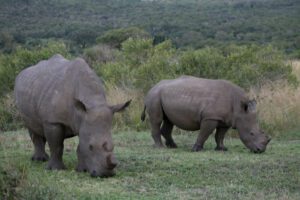
Thabo & Ntombi
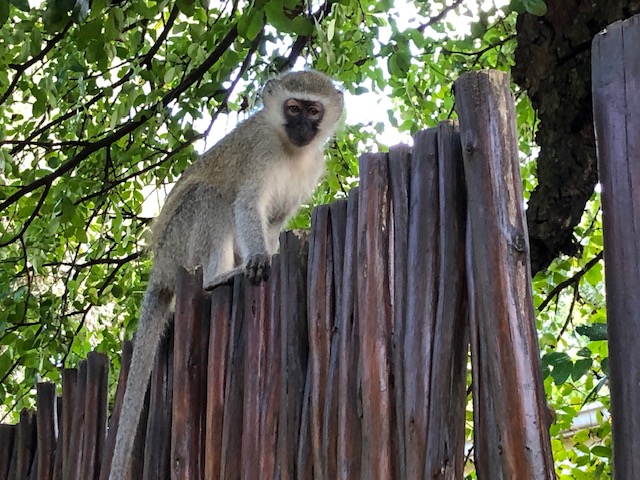
And last of all, the monkeys. I cannot leave a blog entitled, “Misbehaving” without mentioning them. From the first day we arrived in South Africa, we were warned about the monkeys. Not just in the bush but in the city too. “Lock your windows. Don’t leave anything out. They especially like sweet things.” Etc. Etc. Etc. I found it interesting that the rangers at Thula Thula have names for many of their animals, but not for the monkeys. For storytelling purposes, I have decide to call this little tyrant, Moxie.
Everyone was having their lunch around the outside bar that sits under the trees. The monkeys know when mealtime is and always place themselves above or behind us, biding their time for just the right moment. Dessert was served and just as Jay was taking his spoon to delve into his cheesecake, Moxie came swooping over and took it right out from under him. To add insult to injury, he sat at the end of the bar eating Jay’s cheesecake in front of everyone.
I was told the monkeys are much more brazen when it comes to women. They think we will scream and run away. (Which we usually do.) But not me! No. When that little devil came for my food one day at lunch, I screamed at him. Moxie got bigger and screamed back at me. He even looked like he was going to attack. I was scared but I got bigger and screamed again. It was quite the commotion. Everyone came running out of the kitchen and off he went. “I’m sorry,” Nox said. “I’m so sorry.” “No, no,” I said laughing. “It’s not your fault.”
Jay and I were now fully aware of the schemes these mischievous monkeys deployed. But when there wasn’t any food around, we let our guard down. The very last day, we were waiting at the game lodge for our ride to pick us up and take us to the office to check out. I sat down on the couch and put my purse down on the floor next to me. I took out my phone and proceeded to get up to take a picture. I guess I heard something and turned around. That little devil! In what seemed like two seconds, Moxie had gotten into my purse and had thrown my money across the floor and was continuing to take anything out he could find. I screamed while trying to collect the money and my purse. But Moxie wasn’t giving in. He puffed up his body and looked me straight in the eyes and let out another scream. To which I replied with another scream. Everyone came running out of the kitchen and Moxie fled. A few minutes of chaos led to lots of apologies and laughter. All I can think of when I remember the incident is the scene where Gertie finds ET in the film. That is how I imagine it looked from the outside.
You can see then, that when you go to a private game lodge, you find more than just wild animals. You meet an interesting cast of characters.
0500- We have risen but the sun has not. There is no electricity this morning because all of South Africa is on a rolling blackout schedule. Neither is there any water. This makes for a bit of a challenge as we stumble around our tent with a flashlight. We chose to stay in the Luxury Tented Camp – or rather, I should say – I chose to stay in a tent. (The other choice was the Elephant Safari Lodge.) Jay was suspect of the whole idea, “We are staying in a tent? In the bush? In Africa? He lamented. “Honey, it’s a luxury tent, I replied over and over again. Until today. Now we were actually experiencing living in a tent in the African bush.
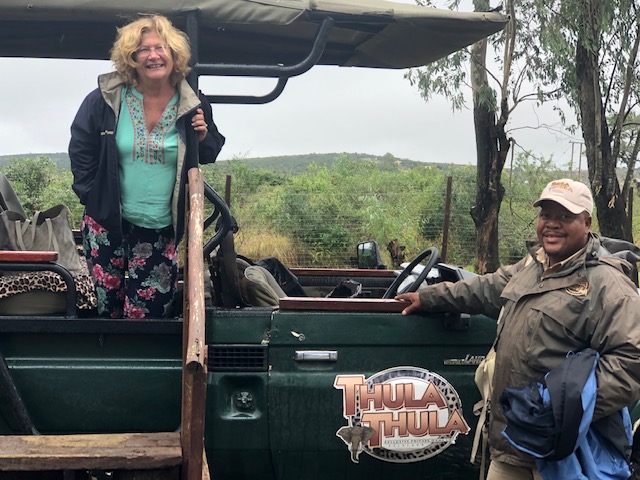
When we arrived at the gates of Thula Thula, we were met by Siya who was not only a ranger but our guide for the entire visit. We were escorted to the office that lies on a hill overlooking all 5000 hectares of Thula Thula. Francoise’s (the owner of Thula Thula) house sits next door. The area is landscaped with a garden and pool. Six dogs greeted us by way of barking. Our tent, we were told, was exactly eight minutes away by Land Cruiser. Jay looked at me with trepidation as we drove deeper and deeper into the bush.
There are eight tents total, and we are staying in tent number eight. It sits at one end of the camp on a platform with decks all around it and an outdoor shower. From the deck we can see miles of bush before us. Inside are two ¾ beds pushed together with mosquito netting. The bathroom has a clawfoot tub, sink and toilet but no proper door, just an opening. Next to the toilet is a screen window looking out into the bush. The floor is wooden and creaks loudly when walked on. There will be no sneaking around in this tent.
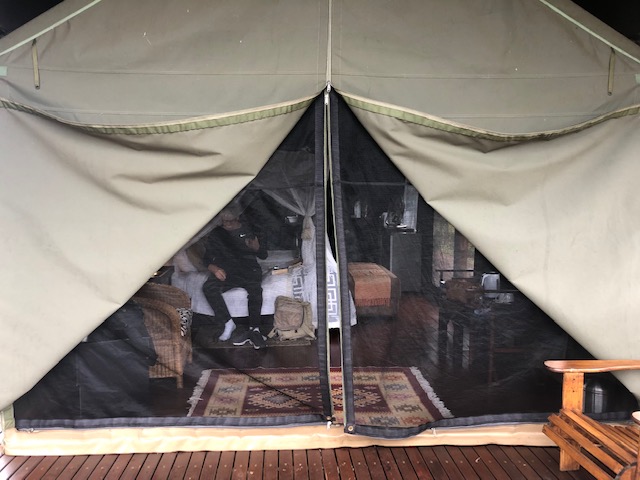
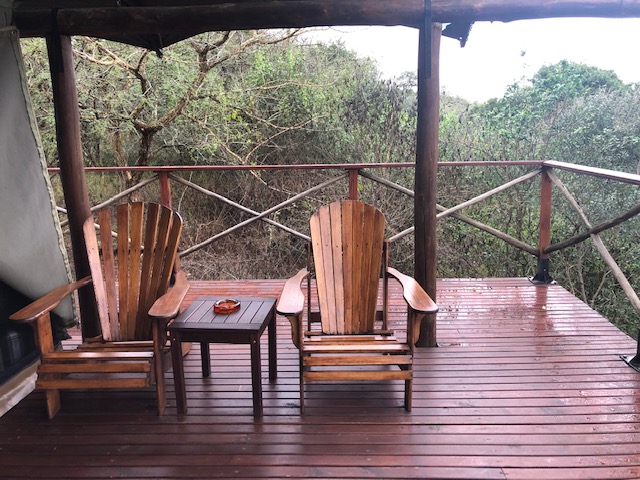
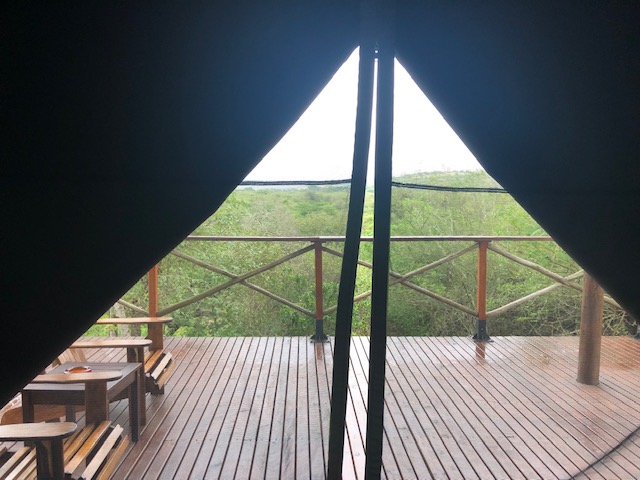
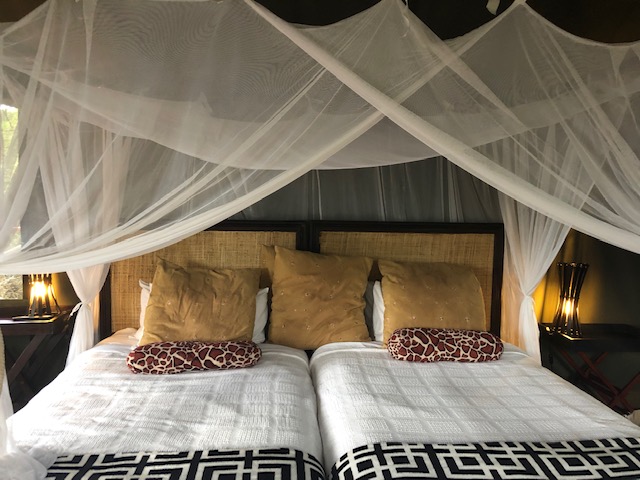
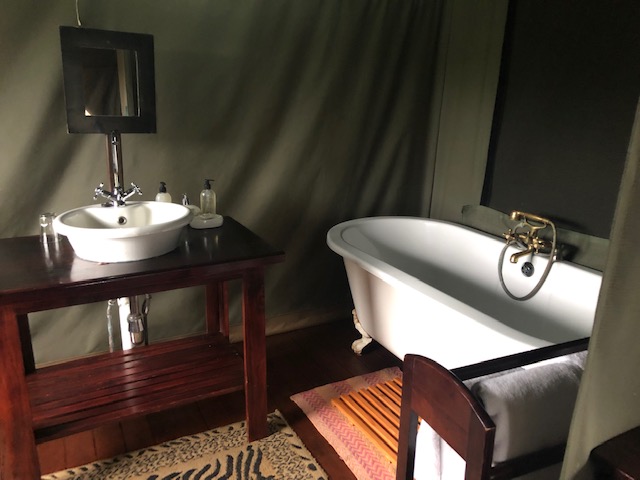
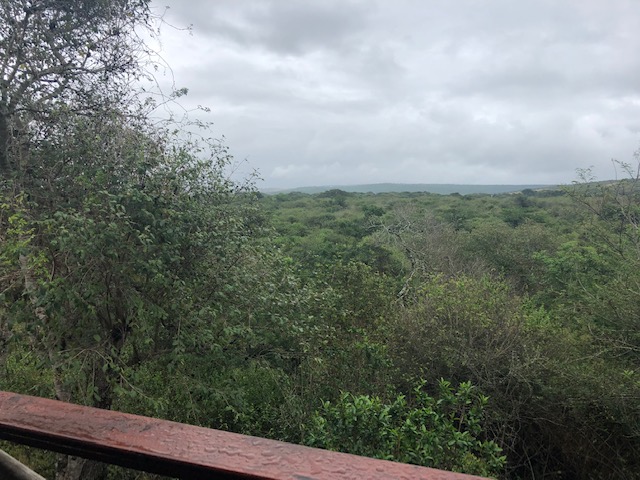
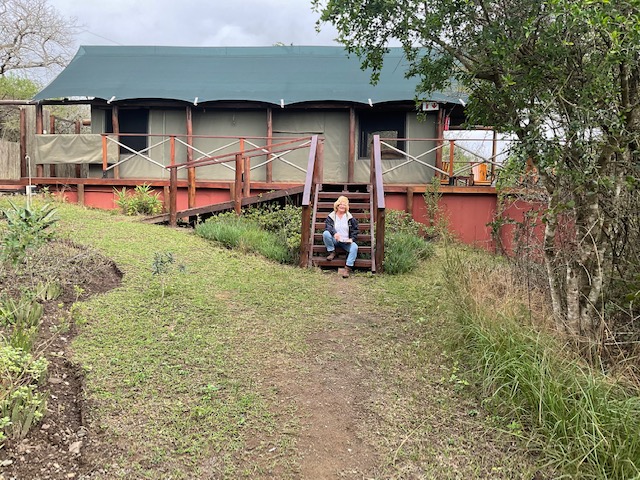
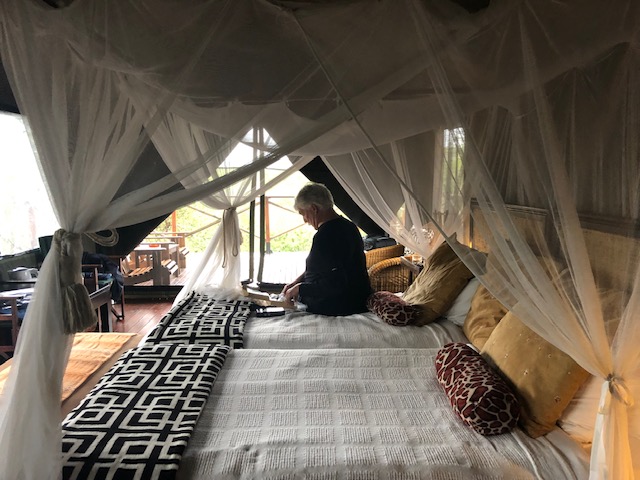
Jay and I find our clothes, brush our teeth with bottled water and make our way out onto the deck. Last night I thought I heard footsteps but when I looked over, Jay was in bed next to me. Outside we see small footprints. “Look! Jay says pointing to the deck, “I thought I heard something last night. Monkeys?” (We were told later that they were bush babies. Somewhat like monkeys but smaller and with very large eyes.) There were many sounds that echoed through the darkness. We heard the rutting call of the impala and the hyena’s eerie cry. It led to a sleepless night.
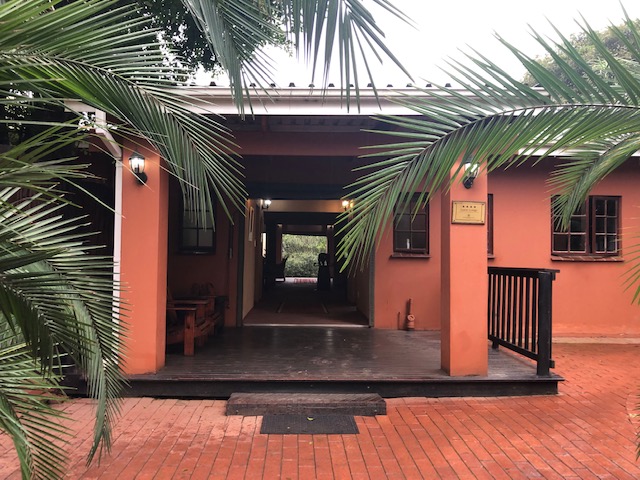
It is damp and chilly as we make our way down the path to the Game Lodge where coffee, tea and muffins await us. The Game Lodge is an open-air building with dining tables, a bar, couches and tables and overlooks the swimming pool and a manicured lawn. The walls are filled with newspaper articles and photos covering the many years of accomplishments made in conservation here at Thula Thula. Monkeys lurk in the trees surrounding the lodge. They wait for the perfect opportunity to steal food, any food. This morning they are not so lucky. Our waitress, Nox, shoos them away with what looks like a slingshot. She doesn’t actually use it, just threatens to.
-

- Entrance to Game Lodge
-
- Interior Game Lodge

-
- Monkey Lurking
0630 – Siya arrives right on time and we get into the land cruiser. It is an open-air vehicle with enough seats for ten passengers. Today there is just the two of us. We are to have our own private tour.
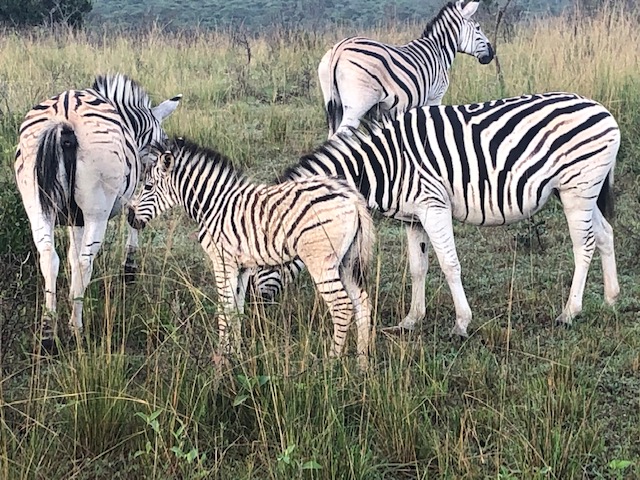
The rain has finally stopped although it is still cloudy. The roads are very muddy and full of potholes. It is very slippery at times. As the sun rises, it reveals a breathtaking landscape. Tall blades of golden grass against the green hills thick with foliage. We can see for miles and miles. We see zebras and nyalas and impalas, by the dozen it seems. With the sound of our motor, a troop of baboons run quickly up the road in front of us. We spend some time with the giraffes, so tall and graceful and unconcerned at our presence.

Siya drives down to the dam where we see a hippo family. Or should I say, spotted them. Sometimes they make funny noises when they stick their heads out of the water. They sound like they are laughing at us.
This is the dam named after Lawrence Anthony, the owner of Thula Thula who passed away in 2012. It is named, umkhulu, the Zulu name for grandfather as that was his nickname. His family and friends scattered Lawrence’s ashes here and on the same day, the elephants came to swim. Siya says they were having their own funeral for Lawrence.

We continue on hoping to see the elephants but this morning, no such luck. The morning game drive is ending. It is time for breakfast.
“Good morning,” Nox says. “This morning we have eggs, bacon, hash browns, tomato and mushrooms. What would you like?” This after a display of yogurt granola, cereals, fruit, muffins and the most delicious crepes. We enjoy our breakfast while Nox patrols for monkeys. After breakfast we have free time until lunch at 1300. We go back to our tent to charge our electronics while the electricity is on. I read. I write. I walk.
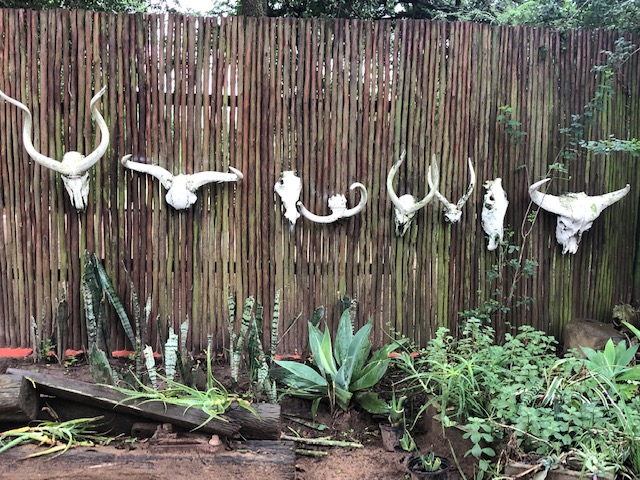
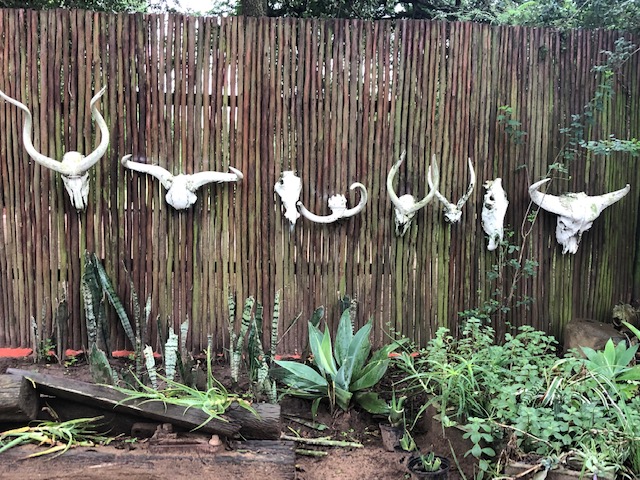
Walking is a bit limited as we can’t leave the camp area. I explore the other tents, the gardens, walk along the pool. Outside the game lodge, I see several skeleton bones. A notice is placed beside the horns as a warning. It says they have been poisoned. This is to keep the poachers from stealing them. (Poaching is a big problem which I will address in a later blog.)
-
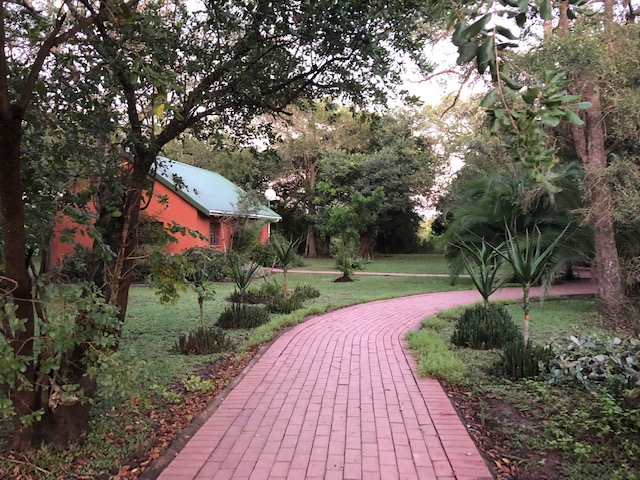
- Pathway to Lodge
-
- Tent Garden area
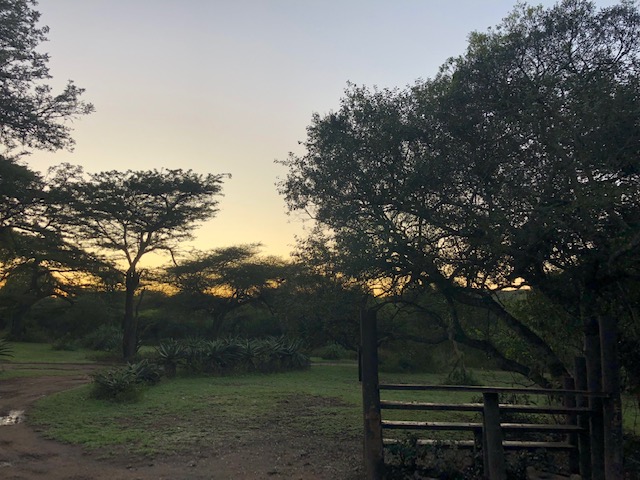
-
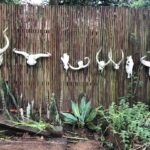
- Animal bones
It is 1300 and it is time to eat again. We are served chicken skewers, salad and mashed yams. Quite good. Desert is offered. I worry that if I continue to eat like this with little exercise, I will gain weight. (I did, six pounds.) More free time after lunch. Jay and I take a nap.
1530 and Siya arrives for our afternoon drive. He packs a cooler with cocktails and appetizers for our sundowner. Two couples from Florida have arrived at the camp this morning and will join us on our drive.
“It is all about the elephants this afternoon,” Siya tells us. We follow their trail of dung and broken branches. We see them on the road up in front of us and then more in the bush and across the river. Siya drives around to the other side of the river to greet the elephants as they move through. We follow them up a hill and to a clearing they use as a runway for small planes and helicopters. Siya says they call it Thula Thula International.
Some elephants are eating. Others are playing. And then there are the bulls bullying each other. A curious one comes over to the land cruiser. That is a little spooky, I think to myself. But Siya talks to them in a calm voice, starts the vehicle and moves back. She backs away.
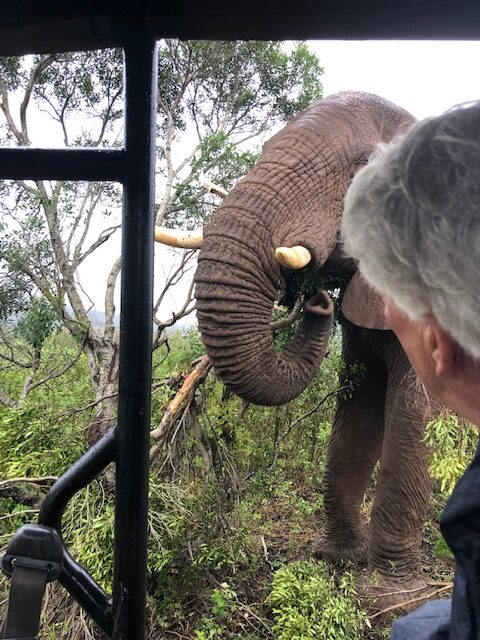
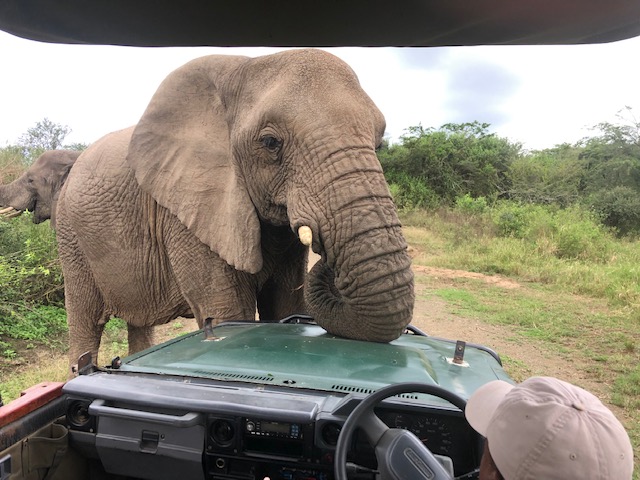
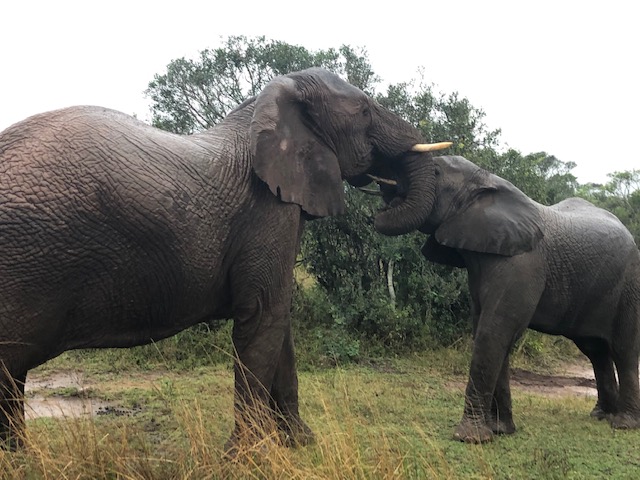
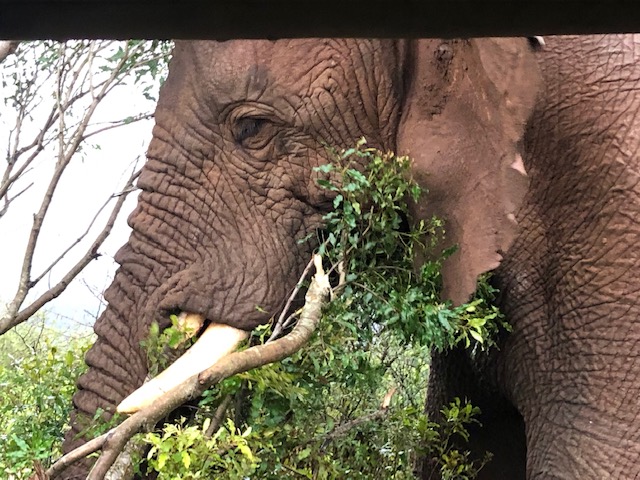
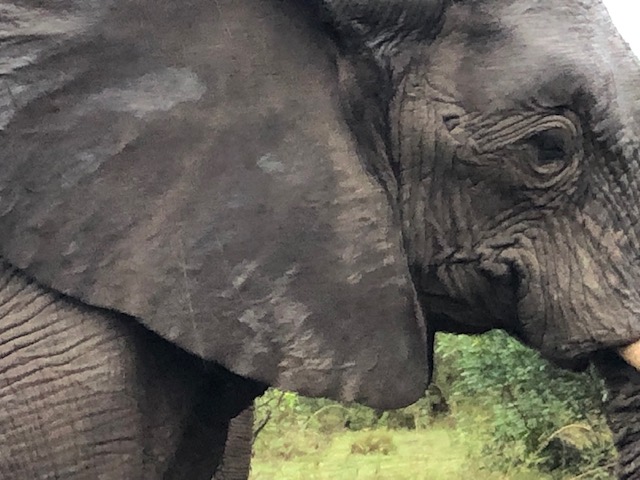
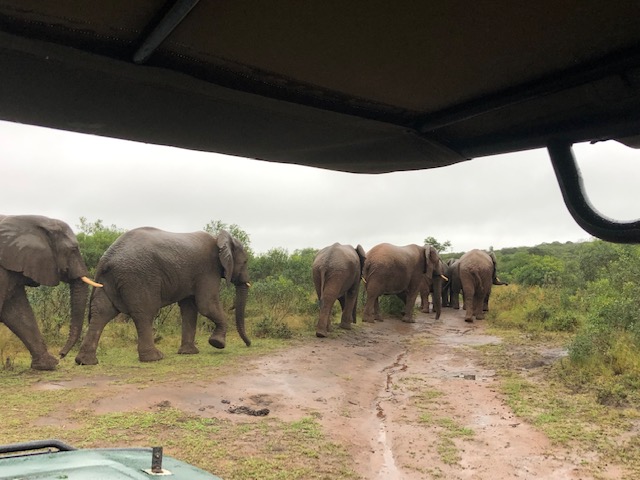
One very special moment is when Mabona comes over to Jay. She is very close. I see Jay tense and at the same time, try to be calm. Mabona takes her trunk and puts it on his shoulder. She moves her trunk ever so slowly down his arm and into his pocket. Jay sits very still. They stare at each other, eye to eye, not even one foot apart. She moves away and we all breathe a sigh of relief. At the same time, we recognize we just witnessed a very spiritual moment. I think Jay will be forever changed.
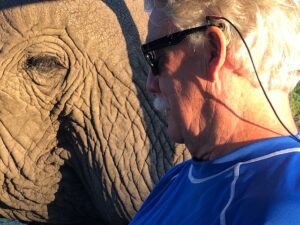
We have spent about two hours with the elephants when Siya takes us high up on a hill. We are invited to step out of the land cruiser and stretch our legs. We stand there overlooking the valley, each lost in our own thoughts. Meanwhile, Siya is putting up a table and tablecloth and laying out our appetizers. He pours our wine, and we all say a toast to this wonderful moment we are enjoying.
Back at the game lodge, we all gather around the bar. Two other ladies and another gentleman who were on a different game drive join us. We compare our stories. Wow! This is like something I would see in a movie or read in a book. But it is us, Jay and me, experiencing this in real life. Awesome. Amazing. Incredible. I am filled with joy.
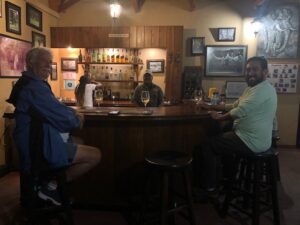
Dinner arrives and it is a buffet with chicken curry and impala ribs, potatoes, rice and vegetables. And of course, desert is offered later.
0830 – We are back in our tent, and I am writing furiously before they turn off the lights again. And then, just like that, the day is over. It won’t be long before I lay down my head and dream of tomorrow.
It was our first game drive. The roads were muddy as it had rained for several days. At 1530 it was chilly and still sprinkling yet nothing could dampen our mood. We were on a search for the elephants of Thula Thula.
I first came upon the knowledge of the private game reserve, Thula Thula, when I saw a blurb on the internet about a man name Lawrence Anthony who had died and his elephant herd came to mourn him at his home for two days. One year to the date, they did the same thing. Lawrence had died in his sleep while in Johannesburg some 600 miles away from Thula Thula. How did they know? It is a mystery and I wanted to know more about this man and his elephants. This took me to a book he wrote called, “The Elephant Whisperer,” a must read for anyone interested in the relationship between man and animals.
Twenty or so years ago, Anthony and his wife, Francoise, started Thula Thula to help preserve the precious wildlife of his homeland. One life-changing day, Lawrence got a phone call from a man asking him to take on a herd of rogue elephants. Lawrence wasn’t ready to handle such a large task but if he didn’t take them, they would be killed. They had been escaping their reserve and frightening the surrounding villagers. Knowing he had to figure a way to save these elephants, he accepted.
Lawrence was to receive the nine elephants in only two weeks and got busy preparing a boma, a smaller enclosure to acclimate them to their surroundings prior to letting them roam in their new home, the 5000 hectares (12,355 acres) of Thula Thula.
Meanwhile, while being put into the trucks to travel to Thula Thula, the elephant herd witnessed the murder of their matriarch and her baby daughter. Only the matriarch’s teenage son and six others were left. They were, understandably, upset and upon arrival at Thula Thula proceeded to escape twice. Fortunately for all they were found before being shot and redirected back to the game reserve.
“The Elephant Whisperer” tells of Lawrence’s incredible feat of calming these seven and getting them to trust at least one human while keeping them feral. It was no easy task.
What developed between them is a story worthy of a book, thus “The Elephant Whisperer.” It was this book and the one that followed, “The Elephant in My Kitchen,” written by his wife, Francoise, after Lawrence had passed, that fueled my dream of an African safari.
And now, here we were, in a place called Zululand. My dream had become a reality. I couldn’t stop smiling as I took in the scenery around me.
Acres and acres of open land, green and thick with dusty brush, stretched out before us. Golden grasslands, reminding me of Sting’s song, “Fields of Gold,” bent gently with the wind. Hills rose in the distance with scattered clouds dipping over their tops. Drops of rain brushed against our faces as we ventured deep into the landscape. Our eyes darted left and right in hopes of seeing the wildlife that calls these grounds their home.
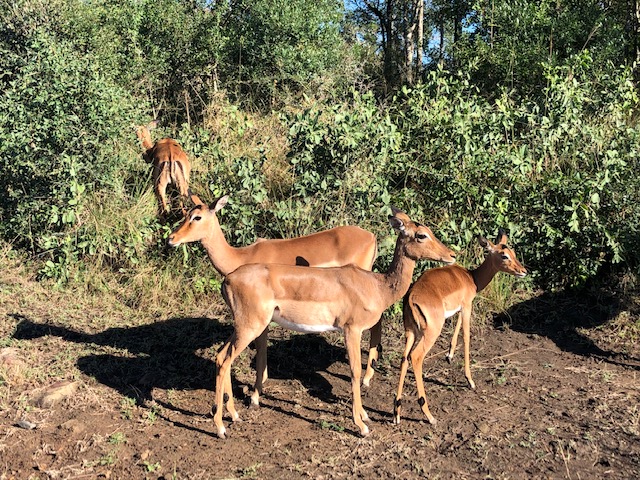
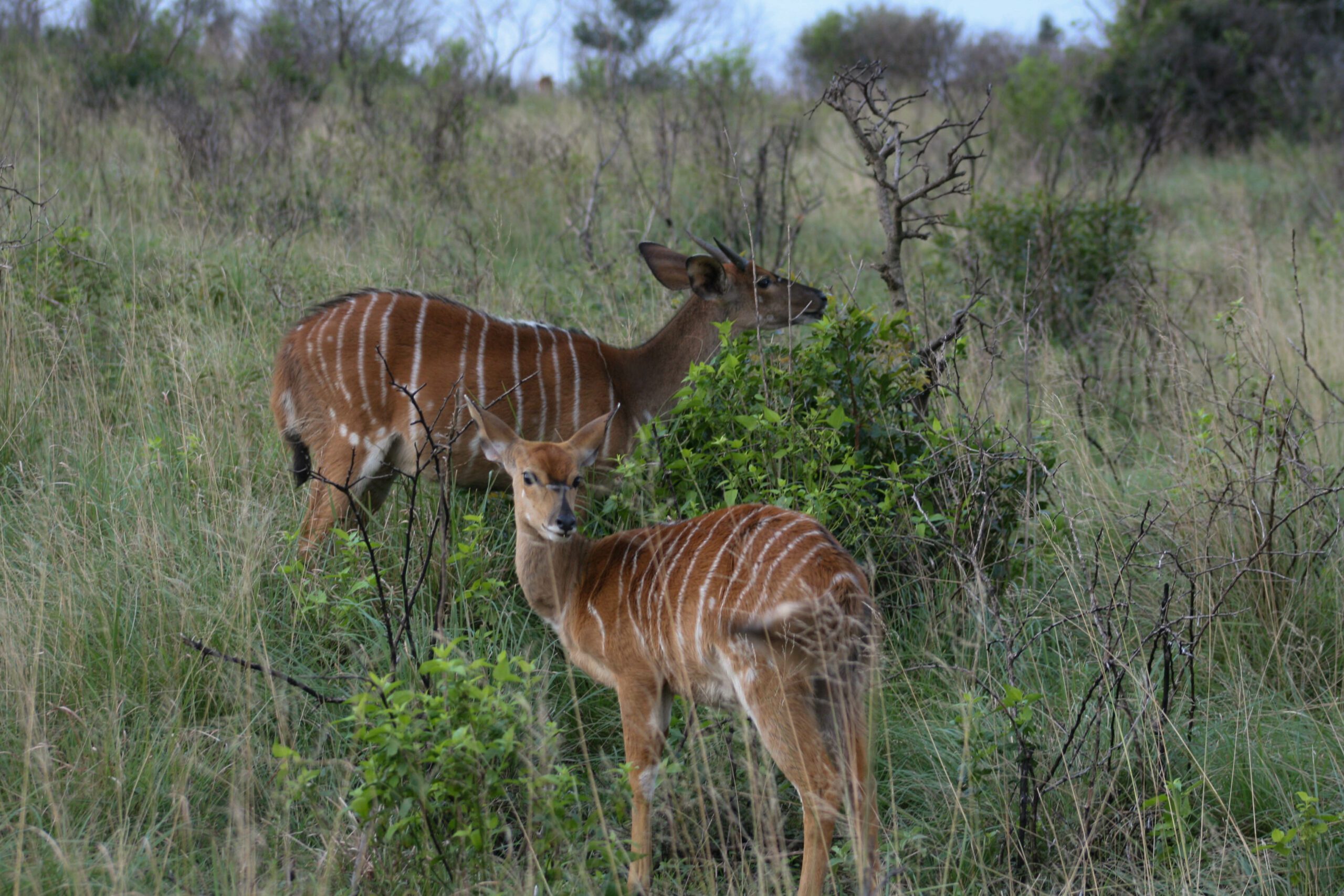
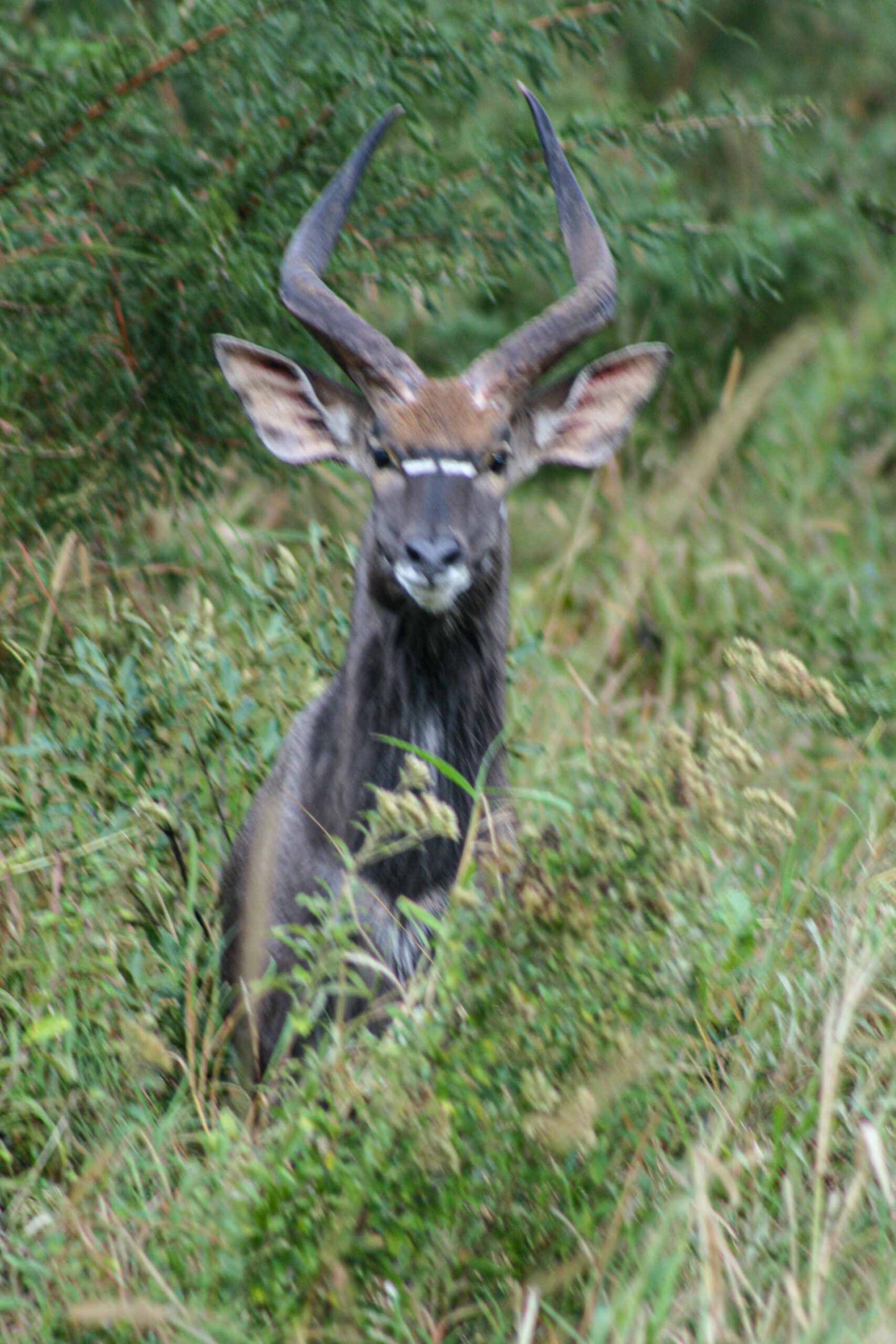
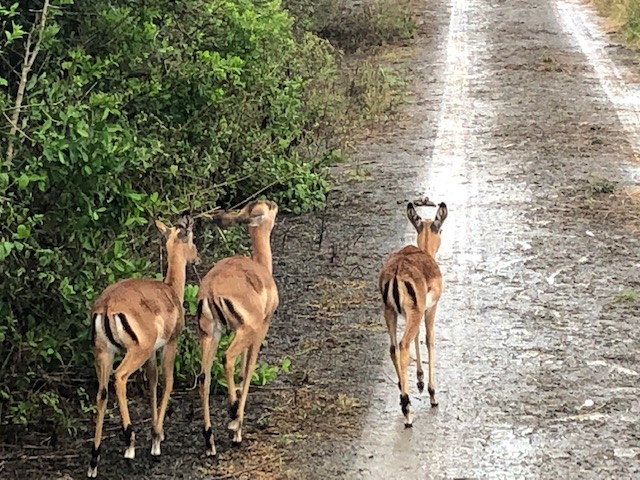
It wasn’t long before we saw impalas and nyalas. Our ranger/guide/driver, Siya (pronounced Seeya), was quick to point them out and explain that they both are a species of antelope. The impalas have a black marking on their bums that look like an M and because of this, and the fact that you can see them everywhere, are nick-named “the McDonalds of the bush.” The female Nyalas are brown with white stripes along their backs. The males are also brown with white stripes but have Mickey Mouse-like ears under their large horns. They have beautiful markings, including two white lines under their eyes to protect them from the glare of the sun.
-

- Nyalas
-
- Male Nyala
-

- Impalas
Siya started noticing broken twigs on the road and fresh elephant dung. He told us the broken twigs were remnants of the elephants’ breakfast. I looked to my left and saw large footprints in the mud. “The elephants were here,” Siya said. “And not long ago.” He followed their tracks. He looked up toward the hills and saw an elephant grazing. “Where?” we asked. “See that dead tree at one o’clock? Now look to the left.” He made it sound so easy. “How do you do that? We asked. “They don’t call me eagle eyes for nothing,” he replied.
Siya has been working at Thula Thula for sixteen years. He knows all about the animals that inhabit this place. He especially knows the elephants. He can identify each one from a distance. He calls them by name. He knows their personalities and they know him. His voice is familiar to them. Most importantly, he can read their mannerisms and their moods, always keeping us safe.
Siya drove us up to where the elephants were. We stayed with them for about an hour, just watching them in their own habitat. Siya explained that they were enjoying the rain as it hadn’t rained in all of April. They began to play. They were feisty, trumpeting and running at each other, slipping and sliding.
Quite honestly, seeing them for the first time with their quick movements was a bit unnerving. It took us a few days to trust that they weren’t going to capsize our vehicle or… maybe something worse. But they didn’t. They were just living their lives not too bothered by us. Once in a while, one of them would come close to the land cruiser, close to our bodies, stare us down. “Stay calm. Don’t worry,” Siya said encouragingly. And after holding our breath and saying a silent prayer we realized they didn’t want to hurt us. They were as curious about us as we were of them.
Stay tuned for more in my African series.
May 5, 2023
It is the wee hours of the morning. Outside my window the sun is rising over the Indian Ocean. I am exhausted from the long hours of travel yesterday but I cannot sleep. Excitement I suppose. We are here. We have arrived in Africa.
The sound of the waves crashing on shore draws me to the terrace. To the East the sky is a muted orange. To the north dark clouds threaten rain. The tide is high. Ships are lined up across the horizon, waiting for their turn to enter the busiest port in Africa. Many people have already begun their day with a walk along the sea. It is cool with no wind.
Our plane landed late yesterday afternoon. As we walked through the airport, we noticed a dramatic contrast to Dubai. We came from a modern city surrounded by desert and dry air to being enveloped in humidity. The building (although built in 2010) seemed worn with age. And it is sparsely populated compared to the throngs of people in Dubai.
It is the beginning of winter here so the sun set quickly once we were on our way to the hotel. Our first glimpse of terrain was of lush green hillsides as we wound along the highway headed for the sea.
We are in uMhlanga in north Durban where we will stay for four nights. It will give us a chance to acclimate to the time change and catch up on some rest.
This is not the Africa I dreamed about. It is a stepping stone until we arrive in the bush. But it is Africa, albeit a different version. One with modern buildings, black rocks and a raging sea.
As one of our guides said, there is much to “unpack” about our journey. There will be many stories to share once we get home and I have some time to gather my thoughts. Until then, I think we should go explore.