

With age comes deep reflection. At least it has for me. As I sit with my thoughts and do, what I name “nothing,” I feel guilty. As if I should be doing something. What is my purpose now, I think? Now that I have raised my children and left my career, who am I? Wife, mother, producer, writer. These have been the ways I have identified myself for decades. Now what? That is when a friend of mine, one who majored in religious studies, introduced me to the Hindu philosophy, ashrama, or the four stages of life.
The first stage of life is called Brahmacharya. This is the period of education and preparing for adulthood. It is the early state of life and potentially goes through college.
The second stage is called Grihastha. This is the period where we create and maintain a home and family.
In the third stage of life, known as Vanaprastha, we start “…detaching from our family life and the pursuit of material ends… and deepen (our) spiritual practice.” This can be done in several ways. Volunteering is one way. Immersing oneself in spiritual texts is another.
In the fourth stage, Sannyasa, “…a person is free to devote themselves entirely to spiritual growth…(to) live a very simple life…The goal is to attain liberation from the cycle of birth and rebirth.”
This has helped me to understand my desire to move inward.
Sometimes I feel like a shapeshifter. I move from the fear of the unknown to the liberation of opening my heart and letting go. Instead of concentrating on the material world which is necessary, but can be – at times – soul stealing, I now have more time to spend in the natural world in prayer and contemplation.
Where did I come from? Where will I go? What has been my purpose here on earth? What is left to do? These questions hang over me like a fog that must be lifted to see forward. I have learned that to gain understanding, I must focus less on my ego and more on my soul.
So much to ponder.
Maybe I’m not doing “nothing” after all.
Photo credit: Tyler Olson/Dreamstime.com
Wednesday, February 26, 2025
The sweet scent of sagebrush drifts across the water from land as we leave the Ipala anchorage. It is 0730 and the sky is cloudy and there is little wind. What breeze there is, is cool, a welcome change from the searing heat of Barra.
We tend to have a lot of down time when cruising. Lots of time to gaze over the water, out into the horizon. This is one of those times. Thoughts arise.
It is our latest mishap that comes to mind, when the block on the main halyard broke, and the mainsail fell. I was at the helm. It wasn’t dangerous, just another thing gone wrong. It was the third thing that broke since we left Paradise Village Marina. I wonder, what is it about the number three?
When I was a little girl, I chose number three as my favorite. My friends were picking numbers like 7, 9 and 11. I went with three. Why? Did I instinctively know the power of three? It turns out, I have since learned the number three is applied in many aspects of our lives.
In one of my workshops, I was taught that the rule of three in writing helps people better understand concepts and situations. I have used that rule frequently without ever knowing the significance.
It is also used in design. Groups of three can create a more dynamic and engaging composition. Hmm…I do this in my own home. Instead of one or two hydrangeas, I will put three in a vase. If I place a centerpiece on a table, it will either be one or three objects. Never two. I find this more aesthetically pleasing.
Three represents the Holy Trinity: the Father, the Son, and the Holy Spirit.
In numerology, three represents creativity – among other things.
Was I destined to choose three or could it be some other reason?
I look over to Jay who is lost in his own thoughts. “My great Aunt Mary once told me,” I say, bringing him back to the present. “That everything happens in threes. First the gooseneck broke. Then…”
“…the bobstay turnbuckle and fitting broke,” Jay finishes.
“And yesterday the main halyard and block attachment broke,” I continue. “That’s three.”
“So, we’re done?” Jay asks.
“We’re done.”
At 1000, we round Corrientes. To my starboard, a curtain of sunlight slices between the clouds revealing the mountain behind it. To my port, tiny birds try to catch fish twice their size as they jump high out of the water, presumably running from bigger fish.
There is still very little wind. The seas are relatively flat. No washing machine effect. This is the sixteenth time we have rounded the cape, and I don’t think we have ever had such a delightful trip. Maybe it’s nature’s way of making up for the Ipala sleigh ride we had on the way down. Maybe she is enticing us with this fair weather, hoping we will make the journey once again.
Once we are in the bay, it feels like we are almost home. We are not. Banderas Bay is huge. We have another five hours before arriving in the marina. As we get closer, I can see the city of Puerto Vallarta off in the distance. The sound of a plane soars overhead. Boats grow in number. Some are whale watching. Others fishing. Some, like us, are sailing.
We are closing in on our home port as another season of cruising comes to an end. All in all, it has been a good trip. True, it has been challenging at times. Maybe that is part of the attraction. It’s always an adventure that frequently takes us out of our comfort zone. I am forced to be awake in the present moment. It may sound strange, but I feel so alive. I feel a visceral connection to all that I am when cruising across the sea, the wind in my face and the sun’s warmth caressing my limbs. It’s exciting. It’s fun. It can be peaceful, and sometimes scary. It’s all that and more. It’s sailing and I love it.
This one is for you, Kathy.
Not much has changed since the first time we sailed down to Barra in 2016.
For those of you who have never been, or maybe never even heard of Barra de Navidad, the town lies on the west coast of mainland Mexico, 135 nm south of Puerto Vallarta and 25 nm north of Manzanillo. It is a favorite of the cruisers.
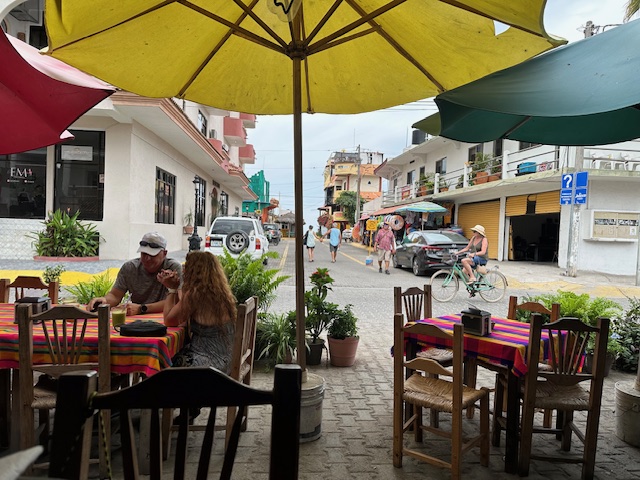
Perhaps we are drawn there because this small village still holds the charm of old Mexico. The narrow cobblestone streets come alive at night. Music drifts out of doorways enticing customers to enter. They will. There are many beach bars where we can sit and watch the sunset. Merchants set out their wares on the sidewalk, tempting tourists who pass by. Many restaurants place their tables street-side with brightly colored tablecloths. Diners enjoy their meals under the stars with a gentle breeze flowing off the ocean. People come and go and sometimes stop to chat.
-
- Breakfast in Barra
-
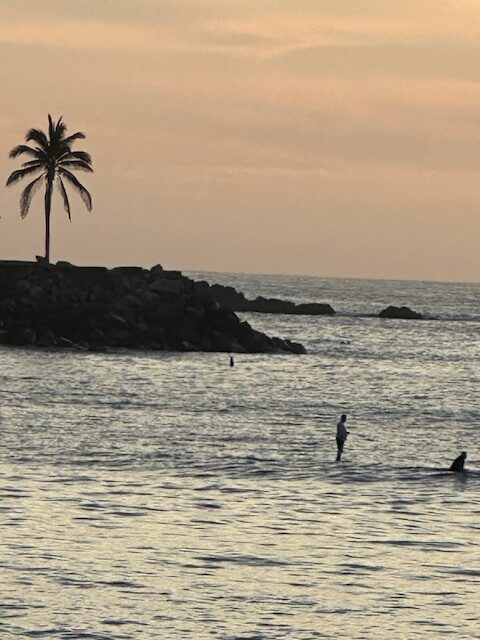
- Surfers outside Barra
-
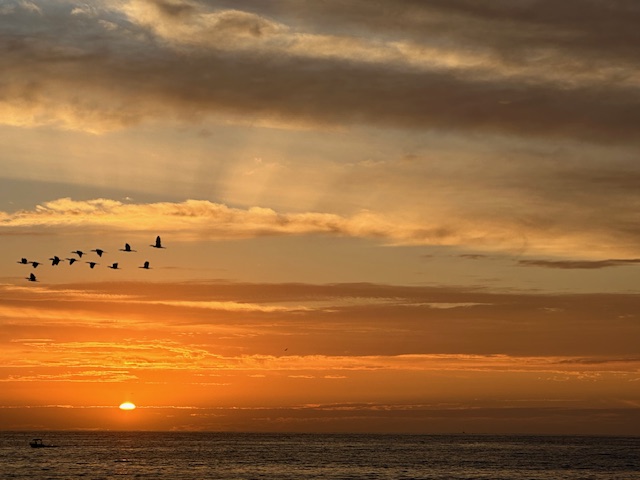
- Sunset from Barra Beach Bar
When we cruisers speak of Barra, we are really speaking of two places. One is the town of Barra that is in the state of Jalisco. The other is the Grand Isla Navidad Resort and Marina which is situated across the estuary and against a hill in the state of Colima. One is opulent. The other is not.
Even after eight years of coming to Barra, we are still stunned by the sight of the Isla Grand Hotel as we pass through the breakwater. It is massive in size and “grand” seems like an understatement. Its many levels stretch across the hillside like a maze. The grounds are beautiful with its lush gardens and walkways. Hammocks hang in the shade of palm trees. They even created their own beach by carving out a small lagoon. Lounge chairs and palapas wait the hotel guests. That is, if they aren’t in one of the many pools.
The lobby sits on the sixth floor with breathtaking views that stretch for miles in every direction. Everywhere you look there is marble. A chandelier hovers over a winding marble staircase that takes the guests from the sixth floor to the fifth-floor restaurant. One of several restaurants in the hotel.
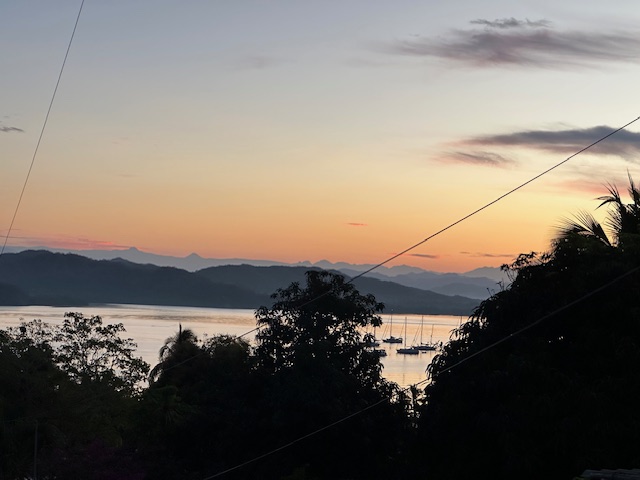
As we enter the breakwater, we must make a choice. Will we anchor in the lagoon? (Not the small beachside one, but another larger lagoon that lies beyond the marina.) Or should we dock our boat in the marina? Jay and I have yet to anchor in the lagoon. I don’t think we will. It is much too shallow. However, I have kayaked, and paddle boarded out to the lagoon. I enjoy the peaceful surroundings. I love trying to pick out the wildlife hiding in the mangroves.
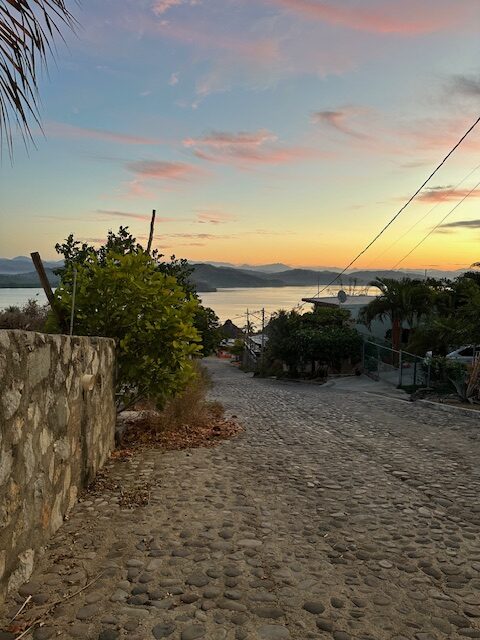
The tiny village of Colimia that sits on the Isla hillside hasn’t grown. It hasn’t changed much either. Like Barra, many restaurants are there one year and gone the next. Mary’s and Fortino’s beach-side restaurants have survived. There is a new restaurant on top of the hill called The View. The have good pizzas and will deliver to your boat.
-
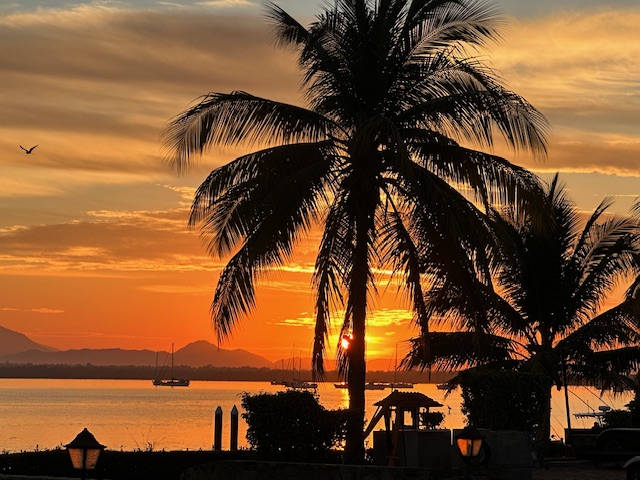
- Sunrise over Barra Lagoon
-
- Street in Columbia
-
- View of Lagoon Anchorage
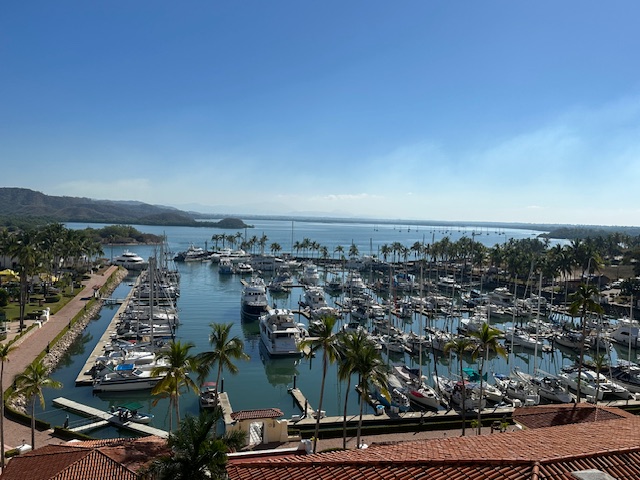
The marina is much the same. The docks are in as poor shape as they were in 2016. I suppose the management knows we will keep coming. And we do. We get the luxury of using the hotel amenities throughout our stay in the marina.
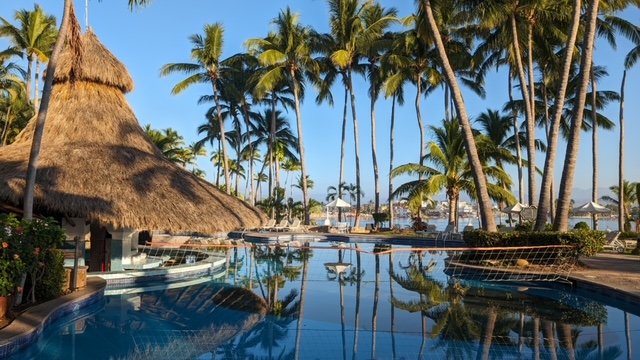
We cruisers like to gather around the pool. It is a chance to catch up with old friends and meet new friends. Pool volleyball has become quite popular. Some prefer the pool bar. There are yoga classes on the beach every morning but Monday. In the afternoon, there is water aerobics and a stretching yoga class on the grass. All are included in the amenities.
-
- Hotel Pool & Pool Bar
-
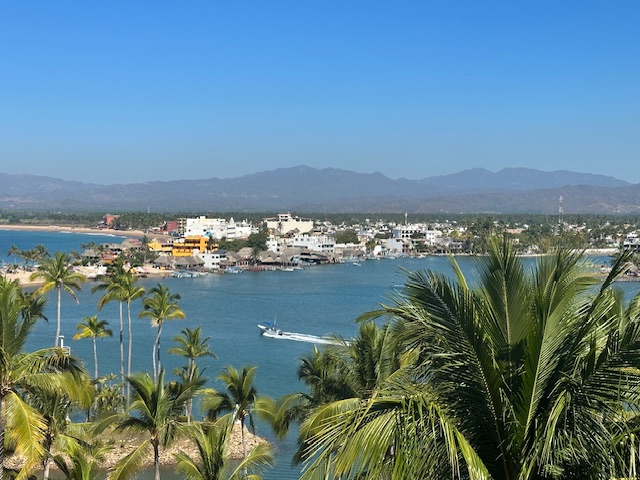
- View of Estuary & Barra from Hotel
-
- View of Marina from Hotel
The French Baker still delivers to the marina and the lagoon every morning but Wednesday. His fresh baked goods are as delicious as always. Especially the chocolate cream and almond croissants. I do believe his sourdough bread is the best in town. The “French Baker” business has sold at least twice since you were here, Kathy. I miss the very first French baker with his authentic accent. You must remember him. Every morning, he would arrive on his panga, ringing his bell to alert us to his arrival. “Hello Lady,” he would greet me in his sing-song voice. How could we not be charmed? The latest “French Baker” sounds suspiciously Mexican. Ah, but it is Mexico, after all.
And the water taxi! Who doesn’t love the water taxi?
“Taxi aquatico, taxi aquatico. Cadenza,” we call on the VHF radio.
“Adelante.”
“Muelle C22 por favor.”
“Okay, momentito,” they answer. Eventually they showed up at our boat. We piled in and smiled while the wind blew our hair. It took us about three minutes to get across the estuary to the town of Barra. A quick ride but so delightful! Round trip for 50 pesos. I think it was 30 in 2016. Still a deal, I think.
It is all these things together. That is why we come back year after year.
Do you remember the time you introduced us to your friend on SV/Liahona? I am sorry to say, I have forgotten the gentleman’s name. I do remember he was a chef. You and Jim arranged for him to pull up to the dock next to us. He cooked a gourmet meal which he served to us on his boat. Afterwards, the instruments came out and the boys serenaded us with tunes. If I remember correctly, you sang along. I did not. I am shy that way. Unless, of course, I have had too many glasses of wine. Then…possibly.
We had so many good times cruising together, Kathy. We miss you and Jim.
Many former cruisers come down to Barra and join us in the month of February. They stay at the hotel or on friend’s boats. Maybe next year? We would love to see you.
It was just after dawn on Tuesday, January 28th when we weighed anchor and headed out. The sky was a clear blue. There was little wind. The sea was relatively flat giving us the perfect opportunity to spot whales. And spot whales we did. Everywhere! Moving, jumping, diving. It was a delightful way to start our day as we motor-sailed toward Cabo Corrientes.
We closed in on Corrientes, and the seas began to toss the boat about. It is a common event due to the change of direction in the mountain range. In the bay, the mountains run north to south and then as we round the corner of Corrientes, they change to more of a northwest to southeast direction. This causes what I call “the washing machine effect.” Not much fun.
The winds slowly picked up to ten knots as we passed the Corrientes lighthouse. Around 1130, I went down to fix lunch and when I came back up, the sea state was decidedly different. I commented on the white caps and watched as the winds continued to escalate while we finished our lunch. With 14 knots of wind, we were sailing seven knots downwind. All good. Except the wind kept picking up and before we knew it, we had 35 knots and six-foot seas, (with the occasional eight-to-ten-foot wave) dead down wind. Not good.
(This 35-knot wind was forecasted for Monday. That is why we waited until Tuesday. According to our friends who left on Monday, it never got over 18 knots. It seems the wind gods were a little late in their delivery and didn’t arrive until Tuesday. Just in time for our rounding.)
We were only about seven miles out from Ipala. Jay figured we could ride it out, hoping the wind would ease up when we got closer to the anchorage. We would sail a little past Ipala, turn into the wind, and drop the sail.
The sail was not reefed, so we were overpowered making it challenging for Jay at the helm. We had an accidental jibe. This is when the wind crosses over the stern of the boat and takes the sail and boom crashing from one side of the boat to the other. It is very unnerving and can be seriously damaging. Next, Jay and Marshall worked together to do a controlled jibe to bring the sail back on the correct wind angle for our destination.
The wind was erratic and every so often, it felt like we were in a vortex, with the wind shifting directions one way, then the other. We ducked as two more accidental jibes knocked us around.
We knew we had to get the sail down as soon as possible. “Let’s wait until a lull in the wind and I’ll turn into the wind. Marshall, you get the sail down as quickly as possible,” Jay said.
While we were waiting, the hull was rocking side to side and up and down with the waves. We were taking waves over the bow and over the side of the boat. Everyone was holding on tightly and I was praying for our safety.
A lull did come. There was a collective momentary sigh of relief.
BAM! We were back up to 35 knots of wind in an instant. “Where did that come from?” we asked each other. Before we could catch our breath, another accidental jibe.
“Duck!” This time the boom got hung up on the stay (the solid metal wire that holds up the mast). Jay had to turn the boat enough to get the boom off the stay. When he did, another accidental jibe happened.
“The boom broke!” Marshall yelled.
“What?” Jay said, incredulously.
“The boom broke,” Marshall repeated as he ran to the mast.
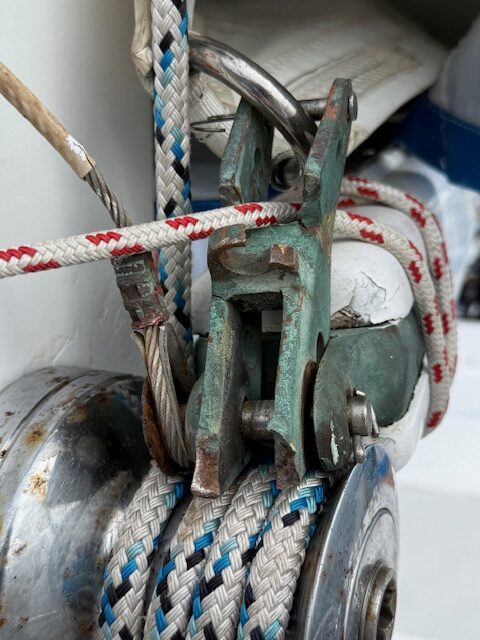
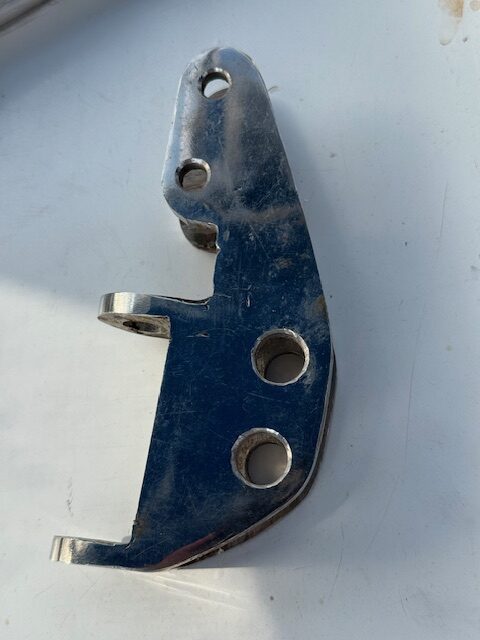
The gooseneck, a solid bronze bracket that was holding the boom to the mast, broke away from the mast. Now we had a fifteen-foot boom with a full 310 square foot mainsail bobbing free in 35 knots of wind and six-foot waves!
“Watch your head!” I yelled to Jay as the end of the boom swayed back and forth.
I watched as Marshall surveyed the damage. He had a slight smile as he got ready to take down the sail. I took that as a good sign.
Taking down the sail was yet another challenge. Cadenza just wouldn’t go into the wind. There was too much pressure. Jay eased the sheet which released some of the pressure. When we were only about 30 degrees off the wind, Marshall was able to wrangle the sail down. With that done, he tied off the boom.
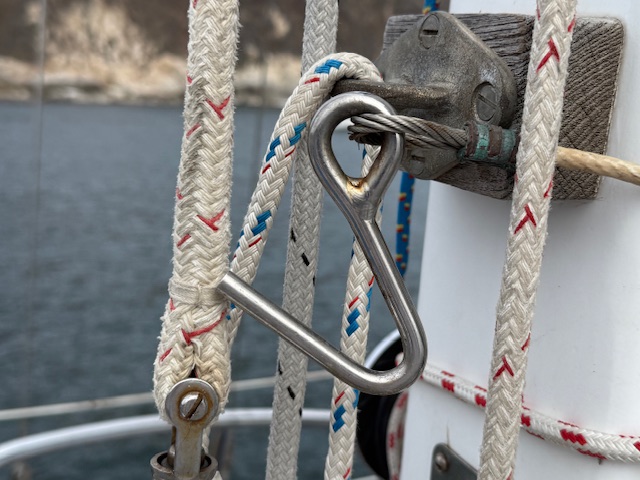
“You are not going to believe this,” Marshall said. “But the reef hook on the boom caught on the jib halyard. That is what is keeping it from moving away from the mast.”
-
- The broken gooseneck sitting on the jib halyard.
-
- The reefing hook that saved us.
-
- The new gooseneck.
Luck, they called it. I call it an answer to my prayers.
Once everything was tied down, we motor-sailed into Ipala. Jay went below to find the spare gooseneck he bought at Minnies over twenty years ago.
“Who has a spare gooseneck on board?” Many of our sailor friends asked later. “That’s crazy.”
Not only that, but it was also an exact fit.
Now that was luck.
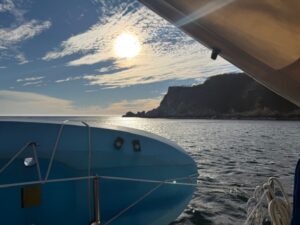
A peaceful sunset at Ipala after an eventful day.
Punta de Mita, Mexico – Wednesday, January 28, 2025 – It’s six-thirty in the morning and still dark. Jay’s alarm goes off. It was our first night at anchor this season, and I have had a fitful sleep. I’m not sure why. Maybe the movement of the boat, rolling. First there was a chill in the air. Then it was hot when the wind died. As the night went on, it turned cold and damp. I snuggled under my sleeping bag and studied the stars, dozing on and off.
The most amazing thing happened last night. As we laid our heads down, we heard the breath of a whale. It was dark, so we couldn’t see it but could tell it was close. It was comforting in an odd sort of way. Like she was there to keep us company.
Yesterday didn’t begin so peacefully. It was noon and we were ready to go. Our friends had gathered to say farewell and to help us off the dock. Jay started the engine. Belts started squeaking. Loudly. SNAP! The alternator belt broke. Okay, not going anywhere for a while. Everybody departs.
Jay and Marshall (our friend/crew member for this trip) checked it out. Marshall offered to run to Auto Zone and pick up another belt. Meanwhile, Jay continued to investigate and realized it was a little more complicated. The problem started with the refrigeration compressor that took weeks to fix. He decided to call our mechanic. Who, most impressively, was able to send his son over by two. By 3:30 the problem was fixed. Only now it was dead low tide. We waited another hour to leave. Our friends returned and sent us off with well wishes for fair winds and following seas.
It was a short motor sail to Punta de Mita where we anchored for the night. Punta de Mita is located on the northern shore of Banderas Bay. You might wonder why we sail north first to sail south. We find it is a great place to pause, get our sea legs and test our boat, before sailing around Cabo Corrientes and further south. If something goes wrong, we are still in the bay and can return to the marina.
We dropped anchor at 7:30 (or 1930) and had a late dinner. We pulled out our sleeping bags and waited for morning.
Today, I watch a lone fisherman in his panga as the sun rises from behind the mountains. I am mesmerized by the calm setting. Just off our stern I notice a whale’s back lying still in the water. I think she is sleeping. Could it be the whale from last night? Jay starts the engine, and she wakes. I watch as she moves off into the deep sea.
Time to get busy. We have a long day ahead of us. Forty-five nautical miles to Ipala, our next anchorage. First, we must sail around Cabo Corrientes which can be challenging. It is known for high winds and washing machine seas. Today the forecast is favorable.
But weather is fickle. Beware. You can never be too sure what the wind gods will bring.
Note: For those who tried to track us. I am so sorry but for some reason, it had us going to Hawaii. We have since made it to Barra de Navidad, our destination for this season.
It is the end of January, and it is time to head south. Jay has been so busy getting the boat ready. It all sounds so grand when we tell people we spend five months in Mexico, sailing. They say, “Ah, you’re living the dream.” It’s not so simple as that. It takes a lot of time and patience to prep the boat. Below is a list of what has been done in the last two months. Sometimes we hire help, but mostly it is Jay who fixes everything.
Replaced the raw water pump.
Tightened the lifelines.
Replaced fender.
Order a new first aid kit.
Switched out and filled propane tanks.
Repaired Dremel tool.
Reattached engine throttle.
Replaced outboard fuel tank and fixed outboard hose.
Caulked seams in teak deck.
Reattached engine throttle.
Replaced outboard fuel tank.
Fixed dodger handle.
Flushed and cleaned bilge.
Fixed wire in tachometer.
Replaced belts on engine.
Fixed leak in head.
Painted life ring.
Replaced shrouds holding up the mast.
Fiber-glassed and repaired spreader.
Checked generator and fire extinguishers.
Replaced two interior lights and clock insert.
Fixed autopilot.
Fixed the engine-driven freezer which entailed resourcing two compressors and many, many hours of labor.
Our latest challenge is the galley faucet that has a leak under the sink, drips constantly, and intermittently plays the theme from Jaws! Jay and Cono attempted to replace the faucet, only the plumbing below the sink is very old and it needs to be replaced. That is a bit more complicated. Jay wisely decided that we would live with the current faucet. If they started cutting and replacing hoses and copper fittings and something went wrong, we would have no water. If that was the case, we wouldn’t be able to leave Monday, the 27th, as planned. He was able to stop the leaking but not the dripping or the musical groans.
It’s a boat. What can I say?
The last two days, we have provisioned, which means going to Costco and La Comer. We filled the freezer, fridge and pantry. Sunday I will cook chili, marinate chicken and make cookies. We will also do laundry and clean the interior boat. Jay is cleaning the exterior of the boat as I write this.
We went to Zaragoza, the marine store in town and got filters and miscellaneous items Jay thinks we will need.
There are lots of little things to do, like tie up the paddle board and kayaks, charge the “marriage savers,” (headphones used to communicate while docking and anchoring) and put out the jack lines. These are used for us to clip in if the weather and seas get rough, so we won’t fall off. There is so much more, but I think you get the picture.
Monday, the day this is posted, we will leave to go south. First stop Punta de Mita. It is still in Banderas Bay and gives us a chance to make sure all things are working as they should be. If you would like to track us, Jay has set up the below link which will show where we are and the wind patterns.
https://forecast.predictwind.com/tracking/display/SVCadenza/
I hate to admit it, but sometimes I act like a spoiled brat. Especially in the light of the horrific fires in Los Angeles that have affected so many people and many of our friends.
It was the middle of December, and our adjustment period was about over. We were acclimated to the heat. All the initial laundry had been done. Jay had reconnected the electronics. The sails were in place. The boat was clean. All that was left was the mechanics and fixing things that were broken. I leave that to Jay. I clean, do laundry, provision, navigate, sail and drive the boat. I used to polish and sand and varnish. Not so much anymore. What else I don’t do, nor do I care to learn, is anything to do with the mechanics. I jokingly call myself “the Vanna White” of boat mechanics. I hand Jay the tools. It was in this environment, that I started complaining.
“I’m bored,” I whined. “I don’t know what to do with myself.”
(To my dear Washashore Writers, I know what you are thinking. Why aren’t you writing?)
Jay was incredulous. “Look around you. Look at this beautiful piece of paradise.”
“It’s not that I am ungrateful,” I said. Jay gave me a look that implied, Sure you’re not.
I ignored him and went on. “I am very appreciative of what we have. It’s just we always do the same thing.”
“What’s wrong with the same thing? Are you saying you are tired of the boat thing?”
“No. No. No. It’s not that.”
“Okay then, why don’t you write? Set up your desk in the salon and write.”
“There’s nothing new to write about. I can’t keep saying the same old thing. It’s not like it used to be when we were cruising new places all the time. I need something fresh to write about.”
(To my dear Washashore Writers, this is my latest excuse. Although if I follow Nancy Aronie’s advice in her latest book, Seven Secrets to the Perfect Personal Essay, she says I don’t have to wait for something inspirational. I can write about anything. Hmm…)
“We used to take a land trip every year,” I continued. “We didn’t do one last year and we’ve done practically every tour around here. I want to do something different.”
Jay just shook his head. He was not happy with me.
Sometime later.
“How about a trip to San Miguel de Allende, Terri. Would that appease you?”
We left on January 9, in the height of the Los Angeles fires. Despite our good fortune, the lives of our fellow Californians were never far from our minds.
I have been hearing about San Miguel de Allende ever since we sailed to Mexico in 2013. Described by Travel and Leisure as “Mexico’s Most Enchanting Destination and the 2021 World’s Best City,” it did not disappoint. In fact, “enchanting” is the perfect word to describe how this beautiful city slowly, with every corner we turned, created a magical experience, with its skinny cobblestone streets, lush gardens and Spanish architecture in the Baroque style.
Getting there, however, was not so picturesque.
There are two airports close to San Miguel: Leon and Queretaro. Each one, we were told, is approximately a 90-minute drive to the city proper. Not knowing about Leon before we left, we chose Queretaro, a town in mid-central Mexico.
It was a quick flight from Puerto Vallarta to Queretaro at one hour and ten minutes. Queretaro airport is relatively small, and we were escorted out of the airplane and onto steps that took us onto the tarmac and ultimately led us inside. Usually when we travel in Mexico we are going to and from the U.S. and must go through customs. This was a domestic flight, and we were delighted in how easy it was to pick up our luggage and leave without all the fuss.
The first thing we noticed was the air was cool and dry. Coming from the humidity of Nuevo Vallarta, it was a nice change.
We were greeted by our driver from the company, Bajiogo, who sent us, and eight other passengers off to San Miguel. (Bajio refers to the region we were in in central Mexico.)
Jay and I sat in the front row as the driver weaved in and out of traffic at a high speed. Mexico is known for its “topes” or speed bumps. They are used in place of stop signs. Imagine this, going as fast as 90 mph and then suddenly stopping for a speed bump and then hitting the gas to go 90 again and then suddenly stopping for another speed bump. Over and over again. Ugh.
“I think the driver must be late for something,” Jay whispered to me. I smiled and held on as I noticed the scenery fly by.
The terrain was high desert. We saw lots of Mesquite trees and cactus (Prickly Pear to us gringos, Napal to the Mexicans) sprouting up from the golden grasses. The city of Queretaro has a typical historical old town, but what we saw was architecturally boring. Rows and rows of low-rise white buildings that all looked the same covered the landscape. Occasionally, a high-rise building rose above, usually hosting a hotel brand name. Nothing exceptional until we arrived in San Miguel.
As we left the outskirts of town and drove toward the urban part of San Miguel, our view changed from flat, dusty highways to extremely narrow cobblestone streets running up and down hills. They were designed for horse and buggies, not cars. And certainly not large vans like the one we were riding in. Sometimes we had to pull over to let a car through that was driving from the opposite direction. Many times, there wasn’t enough room, and we had to back up until there was a side street where we could turn. It was a bit unnerving, but I held on tight and continued to be awed by the beauty around me.
San Miguel de Allende lies against the Sierra Madre Oriental Mountain range at somewhere between 6,000 and 7,000 feet. Much of the old city was built in the 16th century and it was the Spanish influence that gave rise to the Baroque style architecture, particularly when it came to the churches, of which there were many. Besides the churches, it was the doors and windows that drew our attention with their intricately carved exteriors. Some were draped in wreaths and flowers. Others had carved stone around them. The buildings were painted in colors that blended in with the natural environment, tan, grey, terra cotta, and a soft yellow.
Our driver pulled up to a door. There was no signage on the streets (or very little), only doors. We stepped out hesitantly but were instantly welcomed by our hosts. We entered through the narrow passageway into, not just a hotel, but a Mexican museum that transported us into the past with its historical architecture, vibrant art and colorful gardens. We were instantly mesmerized with the beauty that surrounded us.
It was the beginning of a very special experience. Yet, it is important to note; while we were safe and enjoying our trip, we couldn’t help but be pulled to our phones, constantly checking on the fires in Los Angeles. The tragedy touched so many, and some of our friends would learn they lost their houses. Lost everything. It was very difficult to celebrate our good fortune when others were suffering.
So, I write this with gratitude, sadness, and yes, a little bit of guilt.
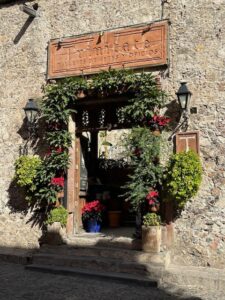
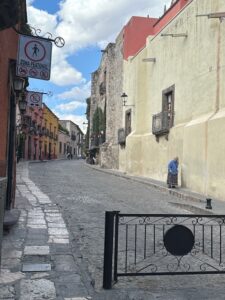
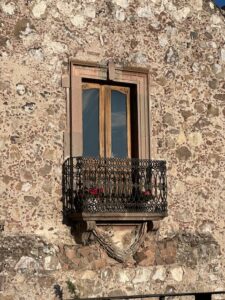
*More blogs to come on San Miguel de Allende and the pyramids we visited.
When Jay and I untied the lines in California eleven years ago, we had no idea how far or for how long we would cruise. We planned to sail south to Mexico and from there, maybe further south and on through the Panama Canal. Maybe we would cross the ocean and reach the beautiful South Pacific islands. It was an adventure into the unknown. It was exciting and, if I’m honest, a bit scary.
We spent two months in San Diego and three weeks in Ensenada. We took a month cruising down the west coast of Baja California where we stopped at small coves with tiny villages. We spent days that turned into nights that turned into days, sailing. The seas were sometimes rough and sometimes flat. The winds were sometimes strong and sometimes still. We cooked and fished and swam and slept. It was everything I hoped it would be.
We arrived in La Paz in the late fall of 2013 and spent the winter season cruising the Sea of Cortez. There we were greeted with whales and dolphins swimming in turquoise water. Rocky, arid desert terrain stood in stark contrast to the sandy white beaches and blue ocean.
The following season, we crossed the Sea to Mazatlán, visited the Copper Canyon and stayed long enough to enjoy Mardi Gras. From there, we slowly made our way south, stopping at various inlets until we found our way to Banderas Bay and La Cruz. Several weeks later, we arrived at Paradise Village Marina in Nuevo Vallarta.
I never thought we would land in Mexico and stay in Mexico. I never wanted to be a “marina maiden.” I didn’t want to be “stuck” in a marina. (At least that is how I looked at it at the time.) I wanted to explore the seas, maybe even the world, on our boat. But something changed when I cruised the Sea of Cortez.
It was 2014 and the internet was not as available as it is today. Especially in the more remote parts of Mexico. That meant many weeks, even months, out of communication. Occasionally, if we were lucky, we could get cell reception. I felt isolated from our family. I missed my children. I realized, the further we traveled on the boat, the further away from our family we would be, and that just wasn’t going to work for me. Jay agreed, and since 2016, we have called Paradise Village Marina and Cadenza our “West Coast home” where we live four to six months a year.
Does that mean I am a “marina maiden?” Maybe. Does that mean I’m “stuck” in a marina? Hardly. Every winter season, we cruise out for at least six weeks. We have sailed as far south as Zihuatanejo, approximately 700 nautical miles round trip from Nuevo Vallarta. We anchor out in beautiful bays along the way, and when visiting Barra de Navidad we pull into a marina.
I am happy with our decision. The winter weather here is near perfect. We have incredible sailing grounds in Banderas Bay; flat seas and 15-20 knots of wind every afternoon. Whales everywhere. And the tropics! I love the lush green mountains that rise out of the sea on the south shore. Palm trees and bougainvillea, hibiscus flowers and yucca plants, decorate the landscape. Not to mention all the amenities available at Paradise Village Resort; three swimming pools, a gym and spa, all sitting alongside a beautiful beach that stretches for miles. I still miss our family, but we now have both internet and cell service, and we are close enough to an international airport to get home on a moment’s notice.
Since 2013, I figure we have spent a total of four years living in Mexico. People often ask if it is dangerous. Not any more dangerous than other places in the world. Certainly, I haven’t heard of any school shootings. And, as I have said before, the Mexican people are warm and welcoming and have a great sense of humor. They have an aura of joy that springs forth from their being. Sadly, I don’t see that same kind of joy emanating from those I meet at home. We Americans in the United States carry around a lot of stress and anxiety.
You might wonder what it is like to live on a boat for months at a time. Like anywhere you live, there are pluses and minuses.
There is quite a bit of room on our boat. Cadenza is 45 ’long and 13.5’ wide. We have a galley, a dining table, a separate living area with a settee, and two chairs. (We even have a tv.) We have a head and a shower. The state room has a queen-size bed and lots of storage.
Even though it feels homey and cozy, there are moments when it feels messy and cramped. Especially when there are miscellaneous tools lying about due to a broken something or other that needs to be fixed. Or when we are stepping over each other trying to get past in a skinny thruway. And when the engine room is open and the smell of diesel and fuel seeps out into the air, well honestly, it can be nauseating. When these things happen, we both get a little grumpy, so I counter with a good home-cooked meal. That usually brightens our mood.
We spend a lot of time outdoors. This makes me very happy. We have our morning coffee in the cockpit with a view of the river and mountains, listening to the morning songs of the birds. We often see the sun rise and always watch the sun set. Cocktail hour and dinners are also often spent in the cockpit. Magnificent Frigatebirds flying overhead, looking to steal food from the gulls, is our evening entertainment. Sometimes they succeed. Many times, they do not.
They say community is good for our health, particularly when we get older. We have a great group of friends here. We have lots of visitors who stop by our boat just to say hello or have a chat. We have our own WhatsApp group and share tools, advice, and recipes. We have a weekly get together where we share food and stories.
When we are cruising, the boating community really rallies. We keep in touch via VHF radio and if anyone needs anything, or finds themselves in trouble, there is usually someone close by who is willing to help.
There are so many blessings that come with our lifestyle, but my absolute favorite thing about living on a boat is when we are at anchor. The gentle motion of the boat. The night sky. The countless stars. Breathing in the fresh air. All things together quiet the mind. It is where I find peace.
So, where do we go from here? I tend to wonder (and worry) what the future will look like while constantly bringing myself back to the here and now. I want to be present and honor this very special season of our lives. This, like all things, won’t last forever.
Sunday, December 8, 2024
Moving straight onto a sailboat after eight months of it sitting in the heat of the tropics is quite a shock. First, because we are acclimating to the thirty-degree temperature change. Second, it has been closed tight which tends to distribute the lovely stench of diesel. Actually, it doesn’t distribute as much as invade every pore of every piece of material on the boat. Which means washing every sheet, every towel, and every piece of clothing. Do I have a washing machine on the boat? Of course not. I fill our cart and lug it up to the laundromat that is about a quarter mile walk. Often it is at low tide which adds a steep hill to the walk. When I get to the laundry, only one half of the machines work and half of those are usually in use. I press cold water and get hot water. The dryers are so hot, the clothes burn my hands. I have made this trip at least five times in the last ten days. And this is only the beginning of the work that lies ahead before we can take that long awaited first sail of the season.
(In all fairness, I must note that our caretakers, E2 Yacht Services, did clean the boat – and our interior cushions – prior to our arrival. They did a great first run-through, but it takes so much more as you can see.)
While the boat aired out, Jay connected the electronics and checked the windlass. We crossed our fingers that everything would work. Mostly, it did. Except for the autopilot. Jay recalibrated it and all was good again. We waited for Gilberto who was finishing replacing the exhaust elbow, the shut-off switch and the oil sender. We had new rigging installed and Jay fixed our spreader that was starting to rot. We thought the bow light was broken but it was just a hornets’ nest, blocking the light. I fixed the stern light under Jay’s direction. The mainsail was stored this season so that the boom could be painted. It was. Only it must be done again next season as there are bubbles in the paint. Our sailmakers returned our mainsail, and both the mainsail and genoa are mounted and ready to go. Three light fixtures are broken, and Jay and I are fixing them one by one. Tools are missing or misplaced or rusted when found.
Yesterday, we attacked the dinghy. Our caretakers took the chaps off to clean it but didn’t bother to replace it. I know why. It is a bitch to fit the chaps on the dinghy. Three hours later – this very hot and tired crew (Jay and me) – had the dinghy put together and back on the davits. Now we wait for the outboard motor to be delivered. Meanwhile, we purchased a new bulb fitting for the gas tank. We need to check the propane tanks. Fill the water tanks. Jay put the grill back together. One of the clocks is broken but he was able to get the digital recording barometer working and hanging in its place. Many of the chores take four hands, some take hands that are smaller than mine, others require boat yoga, and always they take a whole lot of patience to complete.
I could go on and on. It’s a boat. It never ends.
I confess. I have been a bit grumpy throughout these past two weeks. It seems to get harder and harder as we get older. I am hot and sore and tired.
BUT
I see the light at the end of the tunnel. Our boat is starting to feel like home again. It is also beginning to feel like a sailboat. I am remembering why we are here. To sail. To cruise. And Jay has finally agreed to go back to our Sunday ritual; mochas on the beach in the morning and no work. Today we are going out on a date. If we can’t be out sailing, Sundays in Paradise are the best.
September, 2024 – Edgartown, Massachusetts
We are ghosting down Katama Bay on Whiskers. The current is behind us, giving us the push that we need to keep from turning on the iron genny. Jay is at the helm and holds the mainsheet, giving me a welcome respite from the responsibility that comes with sailing. Despite our movement, the world feels still. The summer traffic of boats is a memory, reminded only by the bobbing of their bows lying quietly on their moorings. I feel a slight chill in the air, but the sun is still warm enough to keep me from putting on the sweater I brought – just in case.
A dozen Canada geese swim by in formation. The bay appears to be their preference in daylight. At dusk, they will fly over our house, crying out with their distinct honking calls, announcing their flight back to the farm. That seems to be their preference for darkness.
I watch as we pass the mansions on either side of the bay. More and more are popping up along the shore. Each one slightly larger than the next, as if they are in a contest with one another. These are mostly second homes and, sadly, sit empty for most of the year. While others long for a single roof over their head year-round. I feel guilty and blessed at the same time. I wonder who deals the cards of opportunity and why some get more than others.
The wind is fickle today and just as Jay reminds me to be alert, the boom jibes, causing me to duck, saving me from getting hit. I am reminded of a day not so long ago when Jay was not so lucky, and the boom crashed into his head, almost knocking him off the boat.
It was July and the annual weekly celebration of catboats at the Old Sculpin Gallery in Edgartown. During the first half of the twentieth century, the gallery was a sail loft and workshop owned by Manual Swartz Roberts. A beloved man by the entire community, Roberts welcomed local artisans as they settled around him while he perfected his craft, building boats. They came for conversation and a place to create. Often, you would see a painter with his or her sketch pad, pencil in one hand, coffee in another, observing as Roberts put the finishing touches on one of his favorites, the catboat. The catboat is unique to the East Coast; it was initially built for its versatility and is used for both work and pleasure. It is wide enough for scalloping in the winter and comfortable enough to share with one’s family in the summer. It has one large mainsail, and its boom hangs feet off the stern. It was within the walls of the Old Sculpin Gallery that many of them were built. Years passed, and in 1954, when it came time to retire, Manuel Swartz Roberts passed the building on to his favorite friends and fans who would become The Martha’s Vineyard Art Association. It seemed only natural then that in 2021, the artisans of the MV Art Association decided to pay tribute to Manuel Swartz Roberts and his love of catboats and initiated the annual weeklong catboat celebration.
It begins with a welcome reception for catboat owners who gather at the gallery with paintings and photographs documenting catboats over the years. We are offered food and drink while honoring the man who loved these unique boats in the way we do today. Sailors from all over the East Coast mingle in excited anticipation of the parade and race to come.
The catboat parade was to start at noon in the south end of Katama Bay. This year, seventeen catboats of different sizes gathered and raised their sails, waiting for SV/Dolphin and Captain Kurt to lead us down the bay. Meanwhile, the artists marched down Mainstreet in Edgartown, carrying brightly colored parasols and broad smiles. Together with the Mike Benjamin Band, they led tourists and locals to Memorial Wharf to watch and cheer us on as we sailed by.
The parade of catboats rounded from Katama Bay and headed east into Edgartown Harbor proper. Here, it gets a little bit dicey as the throughway narrows between the moored boats and Memorial Wharf. We were all under sail, of course, and couldn’t help but bunch up due to the tight quarters. We were now sailing downwind, which can be precarious on any sailboat, but it is particularly challenging when two or more boats are squeezed into a small space. There were several boats crowded together as we passed Memorial Wharf. Whiskers was in the middle. I was at the helm. Jay was tending the sheet. Our crew, Bill and Dana, were enjoying the ride.
We were getting closer and closer to Memorial Wharf. The boat closest to the wharf started to jibe, which meant his sail was moving from port to starboard and coming right at us. As we were boxed in, there was little to do but yell, “NO! NO! NO!”
I waited for Jay to tell me when to turn, and he did, just in time. The other boat’s sail missed our sail by inches. Literally. Fortunately, the boat to our right saw what was happening and luffed his sail enough to slow down and get out of our way. There was lots of nervous laughter and a sigh of relief as we continued past the lighthouse and into open waters.
We were heading to the race start when the wind picked up. Jay and I agreed that it would probably be wise to reef. I put the boat head to wind. That was my job: to keep the boat head to wind while he and the boys reefed the sail. (Reefing reduces the sail area, which gives us better control in high winds.) By keeping the boat into the wind, the boom will stay centered.
Evidently, I failed at my job, and the boom came crashing across the dodger. There was more yelling, “NO! NO! NO!” and Jay got whacked in the head, sending him across the cockpit and almost overboard. We all huddled around him, asking if he was okay. He sat quietly for a minute, just looking at me.
“No!” I said, “Nope, nope, no. We are not racing. We’re done.” Jay loves to race and is quite competitive, so I knew he was actually contemplating continuing. But he was hurt. Thankfully, there was no concussion, but still, he was hurt more than he realized. The boys agreed with me, and Jay surrendered. We lowered the sail and headed back. I know Jay was disappointed – and I felt terrible – but it was the right thing to do.
This is how our summer season went. We did have a few good sailing days. But there were not as many as we would have liked between my broken foot, our book tour, the birth of our grandson, and the weather. Often, there was no wind. Sometimes too much wind. And then there was a nor’easter.
Five days of heavy winds and rain pummeled Whiskers. Jay was off the island; all I could do was watch and worry. The boom crutch (which holds the boom in place) broke, sending the boom swinging, which tore the dodger we had just fixed from the previous mishap. One of the mooring lines broke. We were lucky that Martha’s Vineyard Shipyard was out checking on boats and saw Whiskers was in trouble. The guys climbed on board and retied her, which held her steady for the rest of the storm.
That was the final blow (no pun intended). We called the shipyard, thanked them for checking on Whiskers, and asked them to pick her up and put her to bed for the winter.
Not one of our better seasons.
But wait! Cadenza is waiting for us in Mexico! Another winter season of sailing is on the horizon.